The Secret of Mitosis: How Scientists Discovered Cell Division
Chromosomes and the Secret of Inheritance
Walther Flemming had shown the precise and orderly sequence of cell division. But what were those mysterious threads? Why did they divide so carefully? And what did they carry?
The answers would come from a new generation of scientists at the turn of the 20th century.
Chromosomes Get Their Name
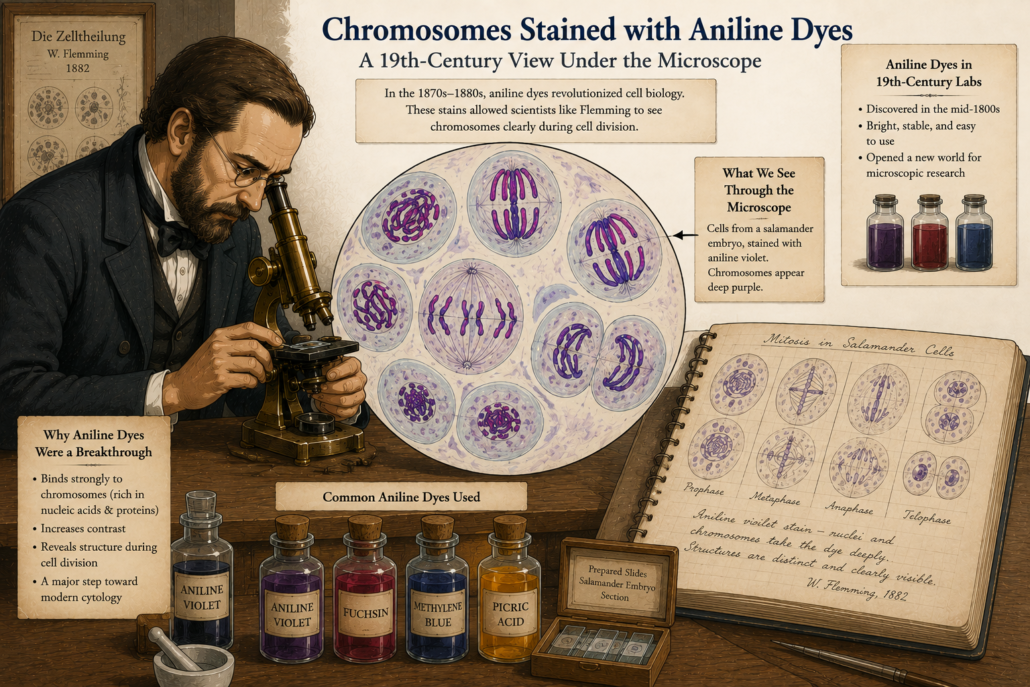
In 1888, a German anatomist named Heinrich Wilhelm Waldeyer gave the threads a new name: chromosomes.
“Chromo” means colour.
“Soma” means body.
Why? Because they picked up colour so vividly with the new dyes. The name stuck, and chromosomes became the stars of cell biology.
Figure 1: Chromosomes stained vividly with aniline dyes under a 19th-century microscope. (cartoon)
From Mitosis to Inheritance
Scientists now knew that chromosomes split evenly during mitosis. That meant daughter cells always received the same number. But another big mystery remained: How were traits passed from parents to offspring?
Gregor Mendel had already published his famous pea plant experiments back in 1866, showing that traits followed mathematical rules of inheritance. Yet his work was forgotten for decades.
When it was rediscovered around 1900, scientists suddenly had two puzzles to connect:
Mendel’s invisible units of heredity.
The visible chromosomes that divided with such precision.
Could they be the same thing?
Theodor Boveri: A Careful Experimenter
The German biologist Theodor Boveri (1862–1915) was one of the first to see the connection.
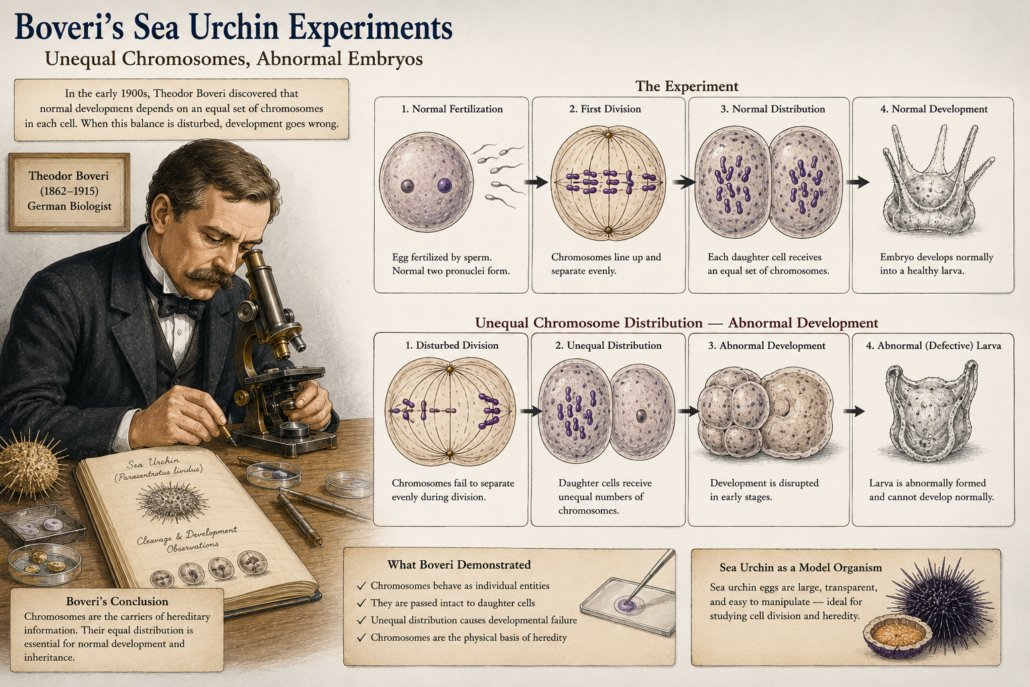
Working with sea urchin eggs, he performed delicate experiments. Sea urchins were perfect because their eggs were transparent, large, and divided rapidly. Boveri discovered something striking:
A cell could not develop properly unless it received a complete set of chromosomes.
If the distribution was abnormal if too many or too few chromosomes went into a cell, development failed.
This meant chromosomes were not just visible threads. They carried essential information needed for life.
Figure 2: Boveri’s sea urchin experiments — showing abnormal embryos when chromosomes were unevenly distributed. (cartoon)
Chromosomes as the Carriers of Heredity
Boveri concluded: chromosomes must be the physical carriers of heredity. Every single one mattered. He was cautious but confident but the chromosomes were not identical; each had unique information. This was revolutionary. He had taken Flemming’s careful descriptions and added a powerful idea: chromosomes were not just for cell division, but also for inheritance of traits.
Walter Sutton and the Chromosome Theory
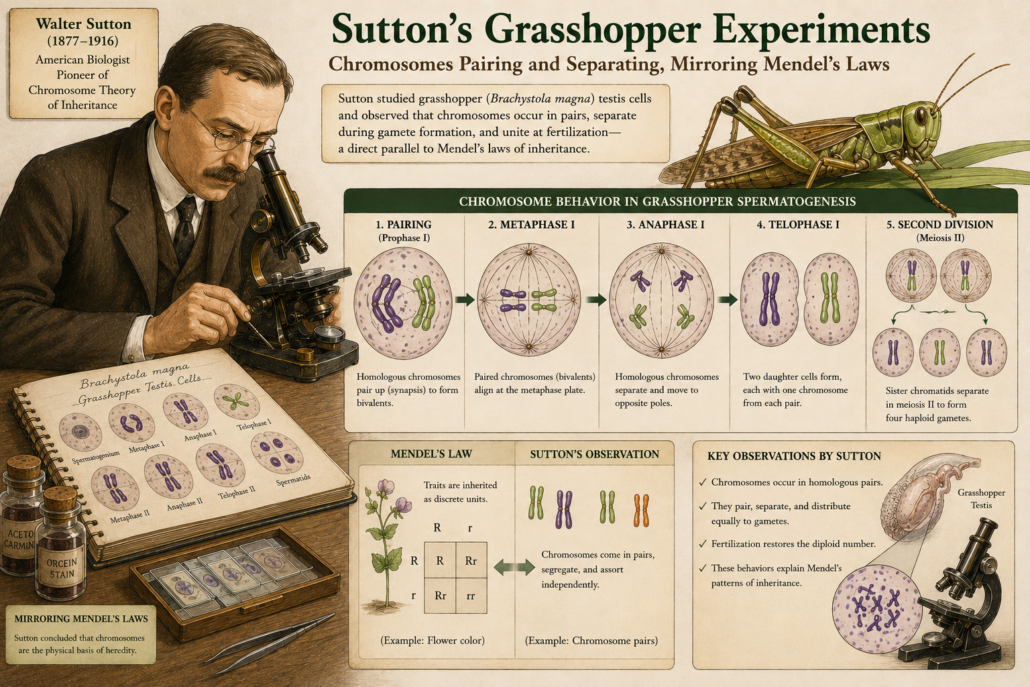
At the same time, across the Atlantic, a young American scientist named Walter Sutton was studying grasshopper cells. In 1902, Sutton noticed that chromosomes came in pairs. During cell division, each pair separated, with one chromosome going to each new cell. He realized this matched Mendel’s laws of inheritance:
Each parent contributes one factor (gene).
The factors separate and combine again in offspring.
Chromosomes behaved exactly like Mendel’s “hereditary units.”
Together, Boveri and Sutton laid the foundation for the chromosome theory of inheritance.
It said:
Genes are located on chromosomes.
Chromosomes are passed from cell to cell, and from parent to offspring, through mitosis and meiosis.
This was the missing link between cell biology and genetics.
Why This Was a Turning Point
Up until Flemming, mitosis was just a strange cellular dance. With Boveri and Sutton, the meaning became clear:
Chromosomes were the carriers of heredity.
Mitosis ensured that every new cell received the full library of instructions.
Life’s continuity, from one cell to another, depended on this precise mechanism.
The mystery of cell division had transformed into the foundation of modern genetics.
A Legacy That Still Shapes Science
Today, we know chromosomes are made of DNA tightly wrapped around proteins. We know they carry thousands of genes that code for every trait in living organisms. But that knowledge rests on the careful experiments of Flemming, Boveri, Sutton, and their colleagues.
They took what seemed like meaningless threads and revealed them as the very carriers of life’s code.
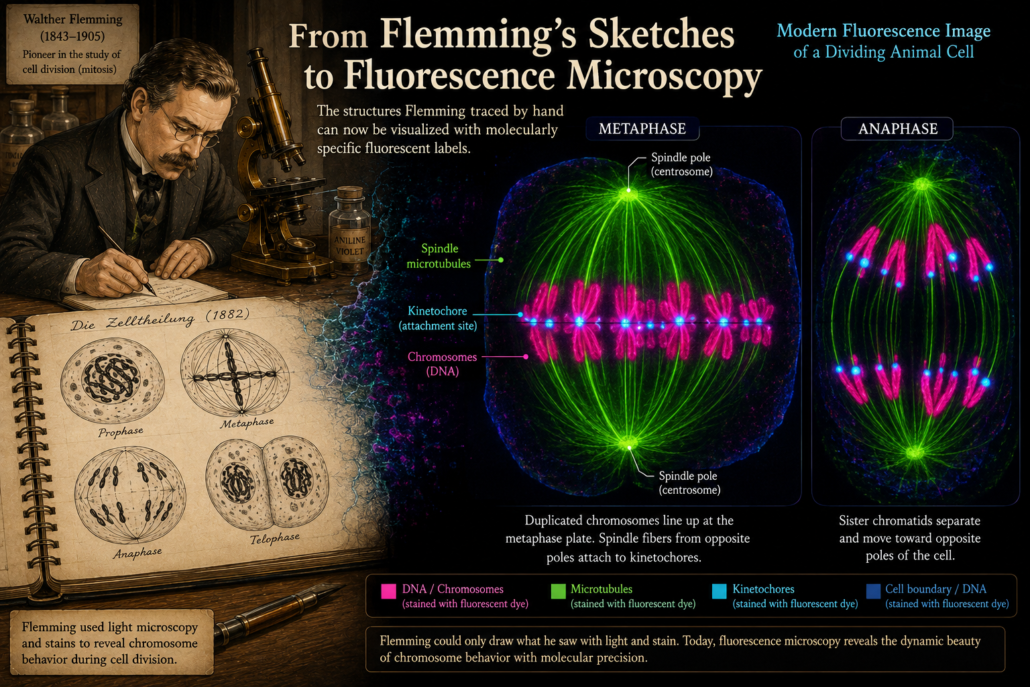
Figure 4: Modern fluorescence image of dividing chromosomes echoing Flemming’s hand-drawn sketches. (cartoon)
Part 5: Why Mitosis Matters Today, we will explore how this history connects to modern science: from cancer research to cloning, stem cells, and genetic medicine. Continue the journey…
Part 5: Why Mitosis Matters. Let, connect the history to modern discoveries and why cell division still holds so many secrets.
https://curiosciencequest.com/wp-content/uploads/2026/09/Part-4-Chromosomes-and-the-Mystery-of-Inheritance.png10241536info@curiosciencequest.comhttp://curiosciencequest.com/wp-content/uploads/2025/03/Untitled_design__1_-removebg-preview-1-300x300.pnginfo@curiosciencequest.com2026-09-04 12:31:422026-09-09 14:42:58Part 4: The story of chromosomes and inheritance
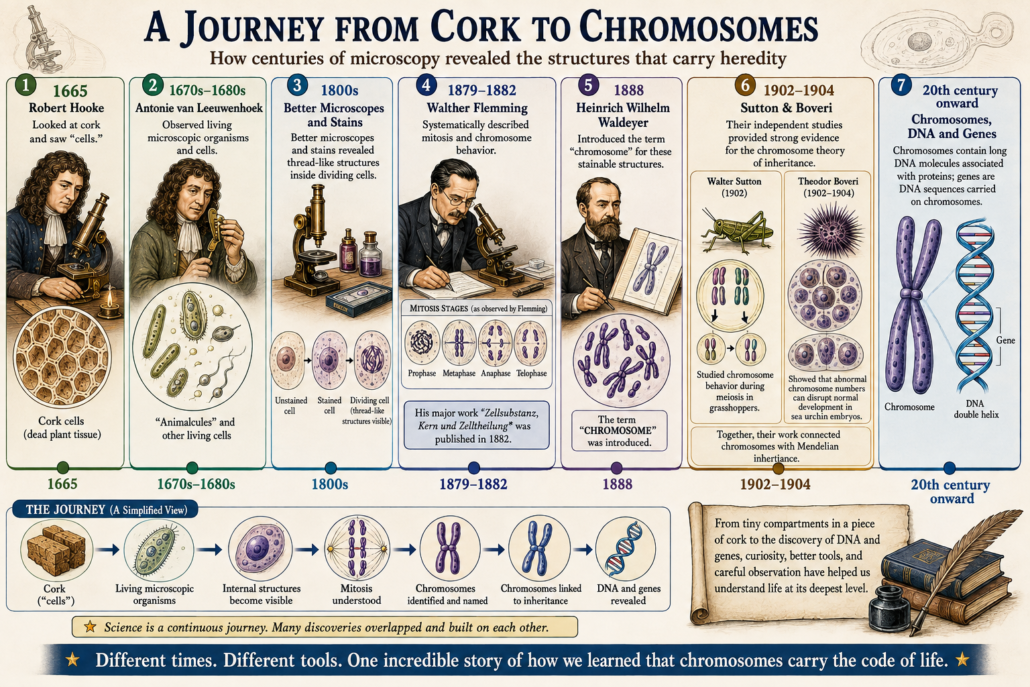
What if the story of genetics began with a piece of cork? Long before scientists understood DNA, genes, or chromosomes, they first had to discover cells and then learn what happened inside them.
Over several centuries, better microscopes, improved staining techniques, careful observations, and new ideas gradually transformed our understanding of life.
Robert Hooke looked at a thin slice of cork and saw tiny compartments, giving them the name “cells.” In the decades that followed, Antonie van Leeuwenhoek revealed a previously invisible world of microscopic organisms.
Robert Brown described the nucleus as a distinct structure in plant cells. Later, improved microscopy allowed scientists to observe the remarkable changes taking place as cells divided.
Matthias Schleiden and Theodor Schwann helped establish the idea that plants and animals are composed of cells.
Rudolf Virchow, building on earlier observations of cell
Robert Brown described the nucleus as a distinct structure in plant cells. Later, improved microscopy allowed scientists to observe the remarkable changes taking place as cells divided.
division, became closely associated with the principle omnis cellula e cellula that new cells arise from pre-existing cells.
Then the story became even more intriguing.
Scientists began seeing mysterious thread-like structures moving and changing during cell division. Walther Flemming systematically described their behaviour during mitosis, while Heinrich Wilhelm Waldeyer later introduced the term “chromosome.”
Finally, the independent work of Walter Sutton and Theodor Boveri provided important evidence linking chromosomes with heredity.
What began with a piece of cork was gradually becoming a much bigger story.
A Journey from Cork to Chromosomes
A story about how life is organized.
A story about how cells reproduce.
And ultimately, a story about how biological information is passed from one generation to the next.
At the centre of this story was one extraordinary idea:
Cells come from cells.
The principle omnis cellula e cellula often translated as “every cell from a cell” became an important part of the developing cell theory. Virchow famously associated the principle with his cellular pathology work, although the understanding that cells arise through division was built on earlier observations, including the work of Robert Remak and others.
This is the journey from cork to chromosomes from simple observations under early microscopes to the foundations of modern cell biology and genetics.
What You’ll Discover in This Five-Part Journey
Part 1: The Birth of Cell Theory — From Robert Hooke’s Cork Cells to Virchow’s Principle
The journey begins in 1665, when Robert Hooke examined a thin slice of cork and saw a pattern of tiny box-like compartments.
He called them “cells.”
Hooke did not yet understand cells as the living units we know today. The cork tissue he observed was dead, and what he mainly saw were the empty spaces bounded by cell walls.
Over the following centuries, microscopes revealed an increasingly complex microscopic world. By 1838 and 1839, Matthias Schleiden and Theodor Schwann had helped establish the idea that plants and animals are composed of cells.
But one crucial question remained:
Where do new cells come from?
Observations of cell division including important work by scientists such as Robert Remak helped challenge the idea that cells could simply arise spontaneously. Virchow’s famous principle, omnis cellula e cellula, became closely associated with the idea that new cells arise from pre-existing cells.
During the 19th century, microscopes became more powerful, and new preparation and staining methods made internal cellular structures easier to observe.
Scientists began noticing something strange.
Inside dividing cells, thread-like material appeared to change shape and move in remarkably organized ways.
These were not random changes.
Something was happening inside the cell.
Researchers studying both plant and animal cells gradually accumulated evidence that cells reproduce through division and that structures within the nucleus undergo dramatic transformations during the process. Early work by scientists including Carl Nägeli, Eduard Strasburger, Friedrich Schneider, and others contributed to this growing picture, even though interpretations were not always correct.
A new mystery emerged:
What were these mysterious threads doing and why did they behave so precisely?
→ Part 2 leads directly to:
The mystery of dividing cells → the changing nuclear material → the search for the mechanism of cell division
Part 3: Walther Flemming and the Discovery of Mitosis
Walther Flemming took the investigation of cell division to a new level.
Using improved staining methods and meticulous microscopic observations, he followed the changing behaviour of nuclear material in dividing animal cells.
Flemming’s observations revealed an ordered sequence.
The material condensed.
It became organized.
It separated.
And it was distributed between the two resulting cells.
He systematically described the process that became known as mitosis, producing some of the earliest detailed accounts of chromosome behaviour during cell division. His major work, Zellsubstanz, Kern und Zelltheilung, was published in 1882.
Today, we describe the major stages as:
Prophase → Metaphase → Anaphase → Telophase
Flemming had revealed something fundamental:
Cell division was not chaos. It followed an astonishingly organized process.
Cell division was not chaos. It followed an astonishingly organized process.
But another mystery remained.
What was the purpose of these thread-like structures?
And could their precise behaviour somehow be connected to heredity?
Part 4: Chromosomes and the Mystery of Inheritance
By the late 19th century, the mysterious thread-like structures seen during cell division had become increasingly important.
In 1888, Heinrich Wilhelm Waldeyer introduced the term:
Chromosome.
Scientists could now give these remarkable structures a name.
But naming them did not explain what they did.
At the beginning of the 20th century, two seemingly separate areas of biology began to converge.
On one side was cell division and chromosome behaviour.
Walter Sutton studied grasshopper chromosomes and noticed that their behaviour during meiosis closely matched the patterns predicted by Mendel’s laws of inheritance. Theodor Boveri’s work on chromosomes and development provided another important line of evidence. Together, their independent contributions helped support the emerging chromosome theory of inheritance.
Suddenly, the story became much bigger:
Cells + Chromosomes + Heredity
Chromosomes were no longer simply structures visible under a microscope.
They were increasingly suspected to be connected to the transmission of biological information from one generation to the next.
And that raised an even deeper question:
What were chromosomes actually made of?
Part 5: Why Mitosis Matters Today
The story does not end with Flemming’s microscope.
Today, the same process he painstakingly observed is studied using fluorescence microscopy, molecular biology, genetics, genome sequencing, and advanced imaging technologies.
Modern science has revealed that chromosomes contain long DNA molecules associated with proteins, and that genes are DNA sequences carried on chromosomes.
But mitosis is not simply a historical curiosity.
Cell division is fundamental to:
Growth
Development
Tissue repair
Stem cell biology
Embryonic developmentCancer research
Regenerative medicine
Every time a cell divides, an extraordinary challenge must be solved:
How can the cell accurately distribute its genetic material to the next generation of cells?
The same fundamental process that Flemming sketched by hand in the 19th century can now be observed with modern molecular tools.
From hand-drawn microscope sketches to fluorescent chromosomes.
From cork to chromosomes.
From chromosomes to DNA.
And from DNA to the genetic instructions that help shape every living organism.
The journey continues.
The microscope changed what humans could see.
Cell theory changed how we understood what we saw.
And chromosomes helped reveal how biological information could pass from one generation to the next.
What You’ll Discover in This Five-Part Journey
From Cork to Chromosomes — A Five-Part Journey
Part _Article
Part 1 _The Birth of Cell Theory
Part 2 _The First Clues of Cell Division
Part 3 _Walther Flemming and the Discovery of Mitosis
https://curiosciencequest.com/wp-content/uploads/2026/08/cork-to-chromosome_hub_image.png9411672info@curiosciencequest.comhttp://curiosciencequest.com/wp-content/uploads/2025/03/Untitled_design__1_-removebg-preview-1-300x300.pnginfo@curiosciencequest.com2026-09-01 20:51:192026-09-09 14:17:54History of Cell Biology: From Hooke’s Cork Cells to Chromosomes
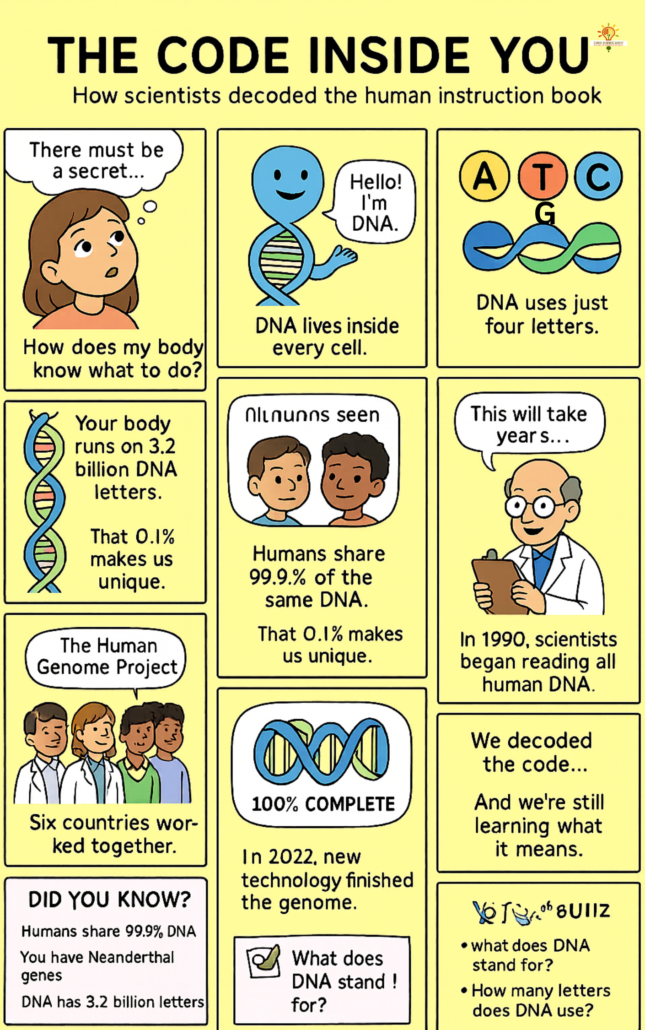
This colourful comic explains how DNA works and how scientists decoded the human genome. It shows that DNA lives inside every cell and is written using just four letters i.e. A, T, C, and G. Although humans look different, we share 99.9% of the same DNA.
The comic also highlights the Human Genome Project, where scientists from around the world worked together to read all 3.2 billion DNA letters in the human body. Completed with new technology in 2022, this discovery helps doctors improve treatments, understand diseases, and learn more about human history.
This comic helps students see how their bodies run on a tiny code and how science is still learning to read it.
https://curiosciencequest.com/wp-content/uploads/2025/12/code-inside.png10241024info@curiosciencequest.comhttp://curiosciencequest.com/wp-content/uploads/2025/03/Untitled_design__1_-removebg-preview-1-300x300.pnginfo@curiosciencequest.com2025-12-15 08:07:432026-09-11 12:03:09How Scientist Decoded The Human Genome
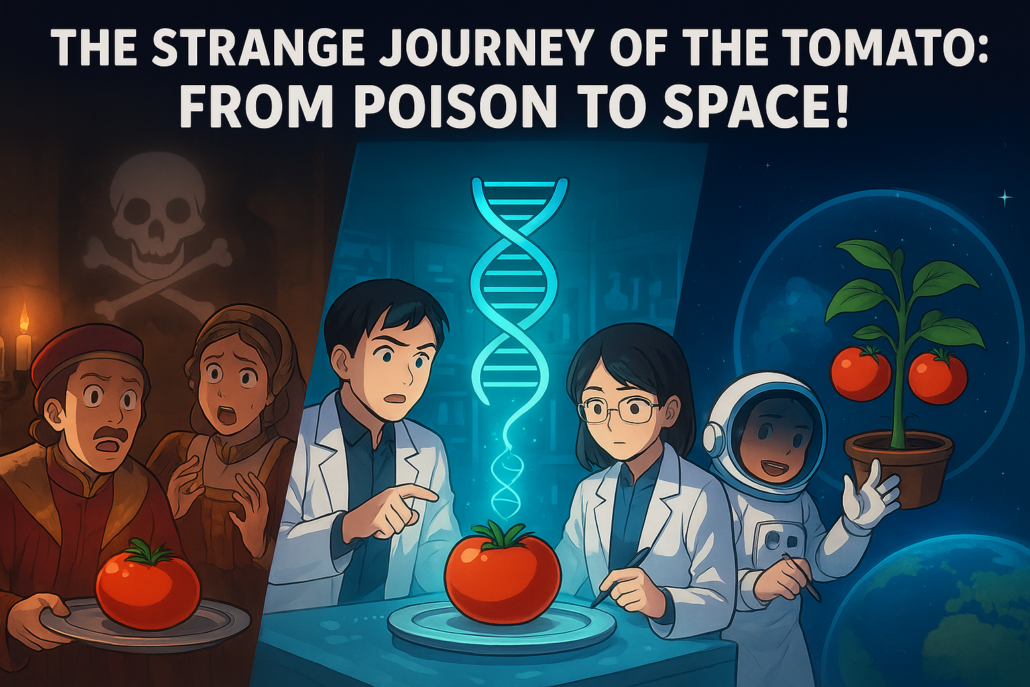
A long time ago in Europe, people were scared of tomatoes. They thought this bright red fruit was deadly poison! Why? Wealthy families ate tomatoes on fancy pewter plates. The acid in the tomato pulled lead from the plates, and the diners often got sick and even died. So, people blamed the tomato instead of the real culprit: lead poisoning.
Years later, science solved the mystery. Tomatoes were not poison at all. In fact, they are full of vitamin C, antioxidants, and lycopene, a compound that helps protect our cells.
But the story does not stop there. Scientists have even grown tomatoes aboard the International Space Station! This experiment teaches us how to grow food in space, where soil and gravity work very differently.
From a feared “killer fruit” to a healthy space crop, the tomato’s journey shows how science uncovers the truth.
https://curiosciencequest.com/wp-content/uploads/2025/09/The-Strange-Journey-Of-Tomato.png10241536info@curiosciencequest.comhttp://curiosciencequest.com/wp-content/uploads/2025/03/Untitled_design__1_-removebg-preview-1-300x300.pnginfo@curiosciencequest.com2025-09-29 12:59:292026-09-09 11:46:35Did You Know Tomatoes Were Once Feared As Deadly Poison?
The Double Helix: A Personal Account of the Discovery of the Structure of DNA
“The Double Helix” is a captivating memoir that chronicles one of the most significant scientific discoveries of the 20th century: The Structure of DNA. Written by James D. Watson, one of the co-discoverers of the DNA double helix, the book offers an insider’s view of the race to elucidate the secret of life.
Summary:
Watson’s narrative is informal and engaging, making complex scientific concepts accessible to readers who may not have background in molecular biology. The book is not typical dry scientific recounting; instead, it is filled with personal anecdotes, vivid character sketches, and an honest-sometimes brutally so-depiction of the key players involved in the discovery, including Francis Crick, Rosalind Franklin, Maurice Wilkins, and others. Watson portrays the scientific environment of the 1950s, which was competitive and driven by a desire for recognition and prestige.
One of the book’s strengths is its candid and unfiltered style. Watson does not shy away from discussing the interpersonal conflicts, rivalries, and even the ethical dilemmas that arose during the discovery process. His portrayal of Rosalind Franklin, in particular, has been widely discussed and criticized for its perceived sexism and lack of appreciation for her contributions. However, this also opens up discussions about the challenges women faced in science during that era, highlighting the biases that existed.
“The Double Helix” is as much a story of human ambition, ego, and collaborations as it is about a scientific breakthrough. It provides a behind-the-scenes look at how scientific discoveries are made- often messy, driven by chance, competition, and personalities of those involved. While Watson’s perspective is subjective and sometimes controversial, it offers an invaluable glimpse into the nature of scientific discovery.
Overall, “The Double Helix” is a compelling read for anyone interested in the history of science, the discovery of DNA, or the personal dynamics of scientific research. Despite its biases and the controversies it has sparked, the book remains a significant and engaging account of one of biology’s most important moments.
http://curiosciencequest.com/wp-content/uploads/2025/03/Untitled_design__1_-removebg-preview-1-300x300.png00info@curiosciencequest.comhttp://curiosciencequest.com/wp-content/uploads/2025/03/Untitled_design__1_-removebg-preview-1-300x300.pnginfo@curiosciencequest.com2025-09-08 09:50:262026-09-09 14:13:15Book Review: The Double Helix
Genome: The Autobiography of a Species in 23 Chapters
Matt Ridley’s Genome: The Autobiography of a species in 23 chapters is an extraordinary exploration of the human genetic code, unravelling the mysteries hidden within our DNA.
Summary:
The book presents a fascinating journey through the 23 pairs of chromosomes that make up the human genome, each chapter delving into a specific gene or genetic concept that has shaped who we are as a species.
Ridley’s writing is engaging and accessible, making complex scientific concepts understandable and exciting for readers of all ages. He weaves together stories of scientific discovery, historical events, and personal anecdotes, painting a vivid picture of how our genes influence everything from our physical traits to our behaviour, health and even our susceptibility to certain diseases.
What makes Genome particularly captivating is Ridley’s ability to connect the science of genetics to broader themes of human identity, evolution and future of medicine. Whether you are a curious teenager, a college student with an interest in biology, or an adult looking to understand the roots of human diversity, this book offers something for everyone. It sparks curiosity about the very building blocks of life and leaves readers with a deeper appreciation for the intricate tapestry of our genetic heritage.
Overall, Genome is a must-read for anyone interested in understanding what makes us human. Ridley’s ability to make science not only understandable but also thrilling ensures that this book will captivate readers of all ages, inspiring them to delve into wonders of genetics.
Gregor Mendel, known as the “Father of Genetics,” was a 19th -century scientist whose pioneering work laid the foundation for the field of genetics. His life story is a powerful testament to persistence, curiosity, and dedication to scientific inquiry. Below is an overview of Mendel’s life, his struggles, and his motivations.
Early Life and Background
Johann Mendel was born on July 20, 1822, in the small village of Hinzendorf (now Hyncice, Czech Republic), Mendel grew up in a humble peasant family. His parents were farmers who recognized his intellectual potential early on and made sacrifices to support his education. At a young age, Mendel showed a strong aptitude for science and mathematics, which set him apart in his rural community. His early experience in the garden, helping his parents with agricultural work, sparked his interest in plants-a passion that would later shape his scientific endeavours.
Struggles in Education
Mendel’s journey in academia was not straightforward. Financial difficulties plagued his family, and Mendel faced numerous obstacles in pursuing higher education. he attended the Gymnasium in Troppau (now Opava) and later moved to the university of Olomouc. However, he had to take a year off due to illness and financial constraints, highlighting his early struggles.
Despite these setbacks, Mendel persisted. At Olomouc, he studied physics and mathematics under the guidance of renowned scientists like Friedrich Franz, who would profoundly influence his scientific thinking. It was here that Mendel’s analytical skills and his interest in natural sciences flourished.
Becoming a Monk and a Scientist
In 1843, at the age of 21, Mendel joined the Augustinian monastery in Brno (Brunn in German), present day Czech Republic, and took the name “Gregor”. The monastery was more than a religious retreat; it was a center for learning and scientific research. The decision to become a monk provided Mendel with financial stability, access to resources, and the intellectual freedom to explore his scientific interests.
Yet, Mendel’s academic journey was filled with challenges. He attempted to become a certified teacher but failed the exam twice due to anxiety and lack of formal training in some subjects. Despite these failures, Mendel did not give up, and continued to teach part-time at the monastery and devoted himself to research instead.
The Pea Plant Experiments
Between 1856 and 1863, Mendel conducted experiments on pea plants in the monastery’s garden. His goal was to understand how traits were inherited from one generation to the next. He meticulously cross-pollinated thousands of pea plants, carefully recording data on traits like flower colour, seed shape, and pod colour.
Mendel’s patience and precision were remarkable. He conducted over 29,000 crosses, which, in biological terms, refer to the process of mating or breeding two organisms to study how traits are inherited in Mendel’s experiments, this involved transferring pollen from one pea plant to the reproductive organs of another, enabling controlled fertilization to observe specific trait inheritance. He meticulously tracked seven specific traits across generations of pea plants. His findings led to the formulation of what we now know as Mendel’s Laws of Inheritance: – the Law of Segregation and the Law of Independent Assortment. These laws explained how traits are passed down from parents to offspring, generation to generation. His studies laid the foundation for the field of genetics.
Struggles for Recognition
Despite the ground-breaking nature of his work, Mendel faced a great struggle for recognition. He published his findings in 1866 in the journal “Proceedings of the Natural History Society of Brunn.” Unfortunately, the scientific community of his time did not understand the significance of his work. Most biologist were focused on Darwin’s theory of evolution, and Mendel’s mathematical approach was too novel for many to appreciate. His work was largely ignored, and Mendel retreated from scientific research.
Later Life and Legacy
After his experiments, Mendel became the abbot of the monastery in 1868, a position that limited his ability to continue his research. He also became involved in administrative duties and a lengthy dispute with the government over taxes, which consumed much of his later years.
Mendel died on January 6, 1884, without receiving any recognition for his discoveries. It was not until 1900, 16 years after his death, that scientists like Hugo de Vries, Carl Correns, and Erich von Tschermak independently rediscovered Mendel’s work. They confirmed his findings and acknowledged him as the “Father of Genetics”.
Motivational Takeaways:
Perseverance in the face of failure: Despite multiple setbacks, including failing his teaching exams and being ignored by scientific community, Mendel continued to pursue his passion for science. This teaches us the importance of resilience and determination.
Curiosity and passion for knowledge: Mendel’s curiosity about nature and his passion for understanding the laws of inheritance led him to ground breaking discoveries. He shows us that a curious mind, when combined with dedication, can change the world.
Legacy beyond recognition: Mendel’s work was not recognized in his lifetime, but his contributions eventually revolutionized science. This underscores that true dedication to a cause can have an impact far beyond one’s own life.
Thinking differently: Mendel’s approach to biology through mathematical principles was ahead of its time. His innovative thinking is a reminder to always look for a new perspectives and methods, even if they go against the norm.
https://curiosciencequest.com/wp-content/uploads/2025/05/Gregor_Mendel_Blog_Featured_Image_2MB.jpg9411672info@curiosciencequest.comhttp://curiosciencequest.com/wp-content/uploads/2025/03/Untitled_design__1_-removebg-preview-1-300x300.pnginfo@curiosciencequest.com2025-05-01 01:03:002026-09-09 13:24:14Gregor Mendel’s Life: From Pea Plants to Scientific Fame
The Great Race Of Life: A Story Of Natural Selection
Life on Earth is an endless race where organisms adapt, struggle, and compete to survive. This race is not guided by deliberate design or modification but unfolds naturally as species interact with their environments. Those with traits that give them an edge thrive, reproduce, and pass on their advantages to the next generation, while others fade away. This process, known as Evolution by Natural Selection, was described and proposed by Charles Darwin and also by Alfred Wallace.
However, Darwin was not the first to propose that life evolves over time. Decades earlier, Jean-Baptiste Lamarck also theorized about evolution, but his ideas differed significantly. Lamarck believed that changes in organisms occurred because nature caused those changes directly, tailoring organisms to their environment. In contrast, Darwin argued that nature acts as a selector, not a designer, sorting organisms based on traits they already possess. This distinction marked a pivotal shift in understanding evolution.
To fully appreciate Darwin’s theory and its differences from Lamarck’s, let us explore Darwin’s journey and the evidence he gathered.
The Voyage of discovery: Darwin’s Evolution of thought
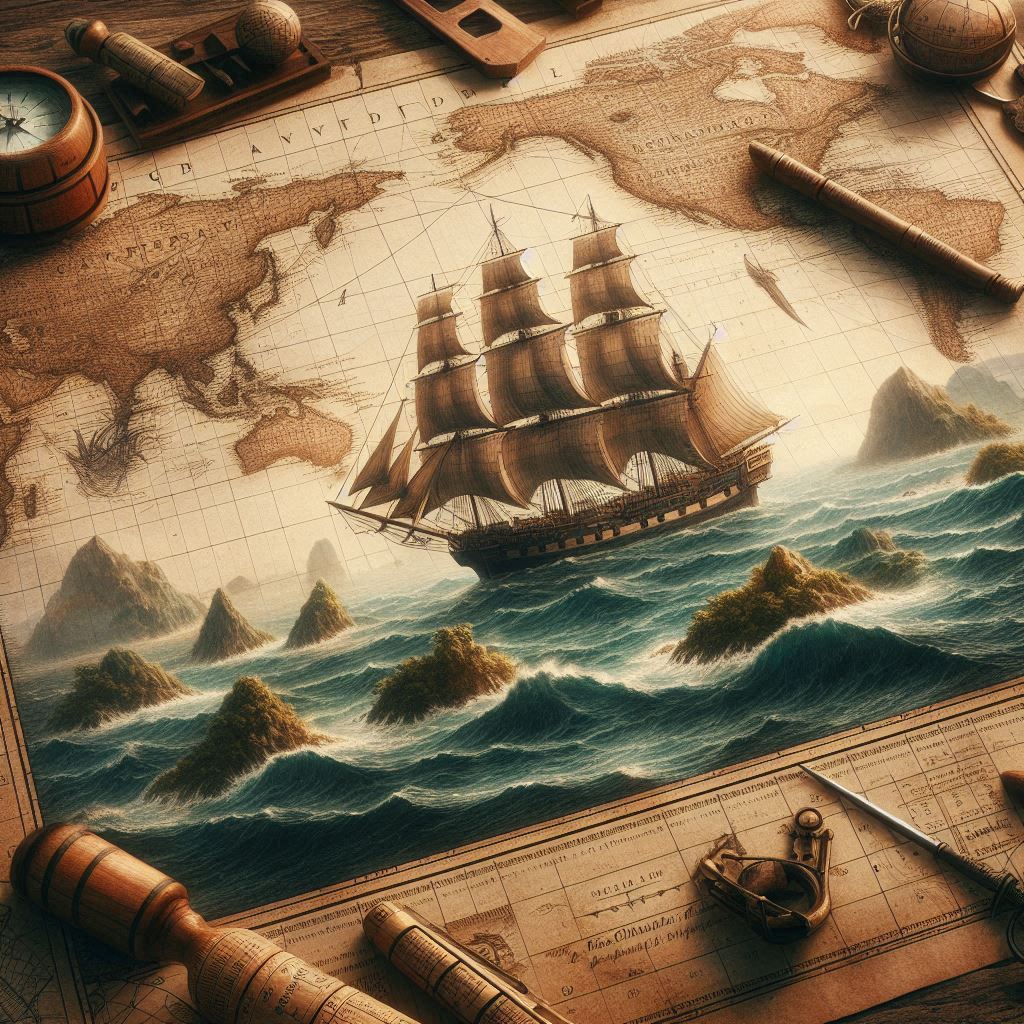
In the early 19TH century, a young and curious Charles Darwin set out on a journey that would transform the way humanity understood life on earth. His voyage aboard the HMS Beagle was not only an expedition across oceans but also an odyssey of discovery into intricate processes shaping the natural world.
His voyage aboard the HMS Beagle was not only an expedition across oceans but also an odyssey of discovery into intricate processes shaping the natural world.
Why did Darwin take the trip?
In 1831, Darwin, then a 22-year-old aspiring naturalist, received an unexpected invitation to join the crew of the HMS Beagle. The ship was tasked with a five-year mission to chart the coastlines of South America and update nautical maps. Darwin was recommended for the position of a naturalist, someone who could collect specimens and make observations about the natural world. Though his father initially opposed the idea, Darwin’s passion for nature and exploration won out. Little did anyone know; this trip would provide the foundation for a ground breaking scientific theory.
The journey was not just adventure- it was an opportunity for Darwin to explore the world’s diversity of life, something that had long intrigued him. The HMS Beagle set sail from England on December 27,1831, stopping at various locations across the southern hemisphere, including South America, Africa, and Australia. The true turning point of the voyage, however, came when the ship arrived at the Galapagos Islands.
Where are the Galapagos Islands?
The Galapagos Islands are a remote archipelago (a group of islands surrounded by sea) located in the Pacific Ocean, about 600 miles west of the coast of Ecuador. The islands are volcanic in origin and are home to a variety of unique plant and animal species. Isolated from the mainland, the Galapagos provided Darwin with a living laboratory for studying life in a way that had not been possible before.
When Darwin arrived at the Galapagos in September 1835, he was stuck by the peculiarities of the islands’ wildlife. Each island seemed to host its own distinct species, similar to but subtly different from those on other islands. These differences hinted at a deeper story of adaptation and evolution. Apparently, this isolation of species on different islands allowed them to evolve independently, resulting in striking variations from their mainland counterparts.
Darwin’s observation in the Galapagos
The finches of the Galápagos were among Darwin’s most famous discoveries. Though not appreciated initially, he soon realized that each island hosted finches with distinct beak shapes and sizes, perfectly adapted to the food available in their specific environments. For example, some finches had large, robust beaks ideal for cracking seeds, while others had slender, pointed beaks suited for eating insects. These variations led Darwin to wonder: Could these birds have originated from a common ancestor and diversified to survive in different conditions?
The islands are volcanic in origin and are home to a variety of unique plant and animal species. Isolated from the mainland, the Galapagos provided Darwin with a living laboratory for studying life in a way that had not been possible before.
The giant tortoises of the Galápagos also captivated Darwin. On one island, the tortoises had long necks and saddle-shaped shells, which allowed them to reach vegetation high off the ground. On another island, the tortoises had dome-shaped shells and shorter necks, suited for feeding on low-lying plants. These adaptations seemed to be perfectly tailored to the environment of each island, suggesting that the tortoises had evolved to fit their habitats.
As Darwin’s observations extended beyond the Galápagos, noticed striking similarities between species on different continents. For example, he observed the rhea, a large, flightless bird from South America, and compared it to the emu in Australia and the ostrich in Africa. Though these birds lived on different continents, they shared many similarities—large bodies, strong legs, and the inability to fly. This was a classic example of convergent evolution, a process in which unrelated species evolve similar traits because they occupy similar ecological niches. The rhea, emu, and ostrich had all evolved to thrive in wide-open spaces, but from different ancestral roots.
In South America, he encountered fossils of extinct animals, such as Megatherium (a giant ground sloth) and Glyptodon (a massive armadillo-like creature). These fossils bore striking resemblances to living species in the same region, hinting at a gradual change over time rather than the sudden, miraculous creation of life.
The Theory of Natural Selection
Darwin’s experiences and observations during the voyage led him to formulate his theory of evolution by natural selection. He theorized that in any population, there are natural variations between individuals. Some of these variations provide an advantage in survival and reproduction in given natural surroundings, allowing those traits to be passed down to future generations. Over time, these small changes could accumulate and lead to the emergence of a new species.
In the case of the Galápagos finches, for instance, birds with the different beak shapes survived in different islands because they were better suited to survive and reproduce in the environment provided by that particular island. This process of natural selection ensured that advantageous traits became more common over generations, eventually leading to the formation of distinct species.
Darwin, however, contradicted Lamarck’s ideas. He argued that various traits naturally occurred in the nature that were inherited through generations, (Darwin’s biggest lacuna is that he did not know how variation occurred. He was not familiar with genetics and genes) not through effort or use.
Contrasts with Lamarck and Other Theories
Darwin’s ideas were not entirely unprecedented. As earlier stated, before him, Jean-Baptiste Lamarck had proposed a theory of evolution based on the inheritance of acquired characteristics. Lamarck believed that organisms could change during their lifetimes and pass these changes on to their offspring to survive in the environment they lived in. For example, he argued that giraffes developed long necks because their ancestors stretched their necks to reach high leaves, and this trait was inherited by the next generation.
Darwin, however, contradicted Lamarck’s ideas. He argued that various traits naturally occurred in the nature that were inherited through generations, (Darwin’s biggest lacuna is that he did not know how variation occurred. He was not familiar with genetics and genes) not through effort or use. In his view, giraffes with naturally longer necks had a survival advantage over those who did not have them in the region which harboured long trees, enabling them to access food which those with shorter necks would not be able to access. Over generations, this advantage would lead to a population dominated by long-necked giraffes. It was the adaptive significance of the long neck variant that would the fittest for survival in that region.
Darwin also challenged other theories prevailing- at that time, such as special creation, which held that species were created in their present form by divine intervention. He disagreed with Georges Cuvier’s catastrophism, a theory championed by, which suggested that species were periodically wiped out by catastrophic events, and new ones were created afterward. Instead, Darwin argued that species evolved gradually over time in response to changes in their environments.
The Impact of Darwin’s Work
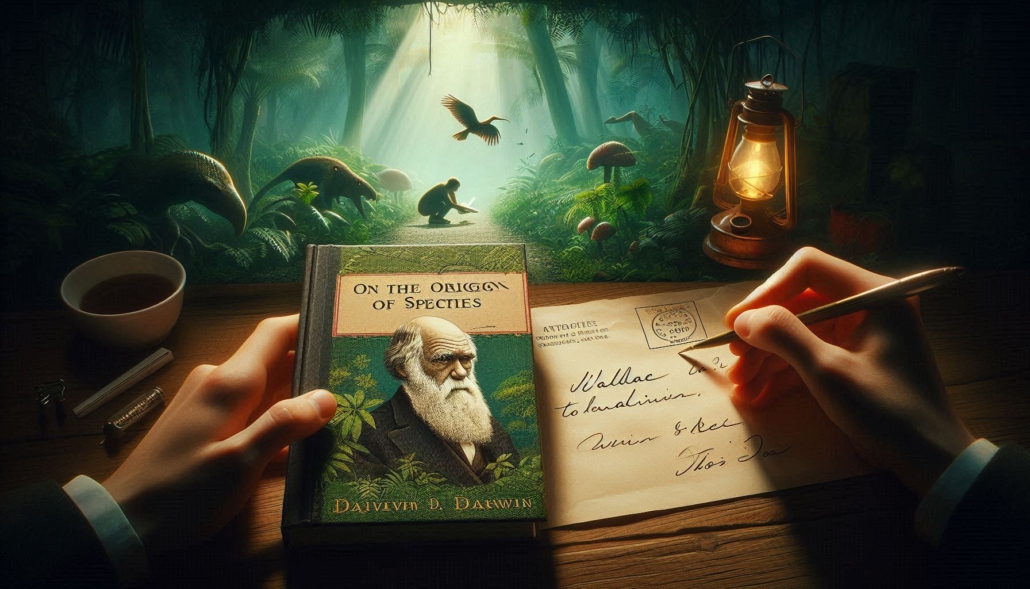
After years of refining his ideas and gathering more evidence during his voyage, he was initially hesitant to publish his ideas. The theory of natural selection was so radical that he feared the backlash it would provoke. However, situation took dramatic turn when in1858, another British naturalist, working in South America and Asia, Alfred Russel Wallace, sent Darwin a manuscript in which he propounded the concept of evolution quite similar to what Darwin had been gathering evidence to demonstrate. He had sent it to Darwin for his comments. Darwin showed this correspondence to his friends and conceded that he had been beaten by Wallace in this race. However, his friends, Hooker and Charles Lyell succeeded in persuading him to present a joint report with Wallace to the Linnean Society of London. Later, Darwin published his book-On the Origin of Specie in 1859, in which- he presented a compelling argument for the theory of evolution by natural selection, drawing on his extensive observations of animals like finches, tortoises, and rheas, as well as fossil evidence. The book forever changed the course of biology.
However, his friends, Hooker and Charles Lyell succeeded in persuading him to present a joint report with Wallace to the Linnean Society of London. Later, Darwin published his book-On the Origin of Specie in 1859
At first, the scientific community was divided, but over time, more and more evidence supported Darwin’s theory. Advances in genetics and palaeontology confirmed that species evolve through gradual changes, driven by natural selection. Today, Darwin’s theory is the foundation of modern biology, and his voyage aboard the HMS Beagle remains one of the most significant journeys of discovery in the history of science.
Darwin’s observations didn’t just map the world’s coastlines they mapped the history of life on Earth. Through his careful studies of the animals, plants, and fossils he encountered, Darwin uncovered the process that drives the evolution of species. Natural selection, he realized, was the key to the understanding of how life changes and adapts. There were no sudden, miraculous events that shaped life, but a slow, continuous process of change, where small differences in traits cumulatively determined survival, and where life evolved in response to the environment. The Galápagos Islands, a living laboratory for evolution, remain a symbol of Darwin’s legacy and the power of curiosity to unlock the mysteries of the natural world.
Darwin’s story reminds us that the great race of life has no finish line and the world is not static; it is ever-changing, shaped by the forces of adaptation and survival. His voyage was not just a journey of discovery but a revelation of the intricate processes that define life itself. The great race of life continues, a testament to the power of chance, variation, and the enduring adaptability of life.
Key Concepts to Remember:
Natural Selection: The process by which species adapt to their environment through survival and reproduction of the fittest.
Adaptation: The process by which an organism becomes better suited to its environment.
Evolution: The gradual change of species over time.
Common Ancestor: The concept that different species share a common evolutionary origin.
Lamarckism vs. Darwinism: Lamarck believed in inheritance of acquired characteristics (e.g., giraffes stretching their necks), while Darwin emphasized the role of natural selection and inherited traits that were advantageous from birth.
Catastrophism (Cuvier): The idea that species were wiped out by sudden, catastrophic events, as opposed to Darwin’s view of gradual change over time.
Convergent Evolution: The idea that similar ecological niches can lead to similar traits developing in different species (e.g., the similar traits of the rhea, emu, and ostrich).
https://curiosciencequest.com/wp-content/uploads/2025/04/ntural_selection_1-e1745933420407.png4101120info@curiosciencequest.comhttp://curiosciencequest.com/wp-content/uploads/2025/03/Untitled_design__1_-removebg-preview-1-300x300.pnginfo@curiosciencequest.com2025-04-29 13:43:442026-09-11 18:18:57Natural Selection Explained: Darwin, Wallace, Lamarck & How Evolution Works
The Tiny Genius That Changed Science: Drosophila melanogaster
The Little Fly With a Big Secret You have probably seen it buzzing around your bananas — tiny, fast, and easy to miss. But did you know this little fly has helped scientists unlock some of the biggest mysteries in biology?
👉 Meet Drosophila melanogaster — the common fruit fly and the unexpected superstar of science!
This tiny insect may live for just a few weeks, but it’s made a massive impact. For over 100 years, scientists have studied fruit flies to discover how traits like eye colour, height, and even diseases are passed from parents to children. In fact, this bug was key to figuring out how genes work — long before we could even see DNA!
From your kitchen to the world’s top laboratories, the fruit fly has proven that even the smallest creatures can make the biggest difference.
A Riddle to Begin…
Let’s start with a riddle:
“Tiny wings, a simple fly, Yet I helped science touch the sky. With mutants, traits, and gene displays, In my short life, I led the way. What insect launched genetic fame?”
Answer:Drosophila melanogaster — The fly that taught humans about heredity!
Why Fruit Flies?
You might wonder: why study flies when we’re trying to understand human biology?
Well, it turns out that fruit flies are a perfect model organism for several reasons:
Short Life Cycle: A fruit fly grows from an egg to an adult in about 10 days. This means scientists can observe many generations quickly.
Simple Genome: Fruit flies have only 4 pairs of chromosomes, making it easier to study their DNA.
Easy to Keep in the Lab: They are small, don’t take up much space, and reproduce quickly — a dream for scientists!
Surprisingly Similar to Humans: Even though they’re tiny, fruit flies share about 60% of their genes with humans. Many of the genes that control development and disease in flies are similar to those in us.
The Beginning of Genetic Discovery
The real fame of Drosophila started in the early 1900s with a scientist named Thomas Hunt Morgan. He and his team at Columbia University began experimenting with fruit flies to understand how traits are passed from one generation to the next.
Here’s what they discovered:
Mutations Matter: By studying flies with white eyes (instead of the usual red), Morgan proved that genes are carried on chromosomes.
Sex-Linked Traits: He also showed that some traits are linked to sex chromosomes, which helped explain why some genetic diseases affect boys more than girls.
Gene Mapping: Morgan’s team created the first genetic maps, showing where genes are located on a chromosome.
For his ground breaking work, Thomas Hunt Morgan won the Nobel Prize in 1933. His research with Drosophila laid the foundation of modern genetics.
A Tiny Teacher in Modern Science
Even after more than 100 years, fruit flies are still teaching us new things!
Here’s what they’re helping us study today:
Brain and Behaviour: Scientists study how fruit fly brains control learning, memory, and sleep.
Disease Research: Fruit flies are used to model diseases like cancer, Parkinson’s, and Alzheimer’s — helping to test treatments.
Development: From a single cell to a full adult, fruit flies help us understand how living things grow and develop.
All of this is possible because we can control and observe mutations easily in fruit flies. Their transparent embryos, fast life cycle, and detailed genetic tools make them ideal for deep scientific exploration.
The Legacy of a Little Fly
From the kitchen counter to the Nobel stage, the journey of Drosophila melanogaster is nothing short of amazing. It has shown the world that even the smallest creatures can reveal life’s biggest secrets.
This tiny fly continues to help us answer questions like:
How do genes control growth?
Why do genetic diseases happen?
Can we fix or treat genetic disorders?
And many more…
Want to Explore More?
If you loved learning about this tiny genius, there’s so much more to explore in the world of genetics! From bacteria and worms to mice and zebrafish, science uses many amazing creatures to unlock the secrets of life.
Subscribe to our website for more fun and fascinating science facts. Share this blog with fellow science lovers, and Tell us in the comments — what other model organisms would you like to learn about next?
💡 Fun Fact:
A single female fruit fly can lay over 500 eggs in her lifetime. No wonder labs always have plenty of flies to study!
https://curiosciencequest.com/wp-content/uploads/2013/12/WhatsApp-Image-2025-04-09-at-8.31.12-PM.jpeg554554info@curiosciencequest.comhttp://curiosciencequest.com/wp-content/uploads/2025/03/Untitled_design__1_-removebg-preview-1-300x300.pnginfo@curiosciencequest.com2025-04-06 18:48:002026-09-03 15:15:31What Can a Fruit Fly Teach Us About Ourselves? More Than You Think
“Gregor Mendel, an Augustinian monk with a passion for experimentation, laid the foundation of modern genetics in the mid-19th century. Through meticulous crossbreeding of pea plants, he uncovered the fundamental laws of inheritance — decades before the discovery of DNA — securing his place in history as the Father of Genetics.”
Gregor Mendel, an Augustinian monk in the mid-19th century, conducted ground breaking experiments that laid the foundation of modern genetics. Working in a monastery garden during the 1850s and 1860s, Mendel systematically cross-pollinated pea plants and meticulously recorded how specific traits—such as flower colour, seed shape, and plant height—were inherited across generations.
He Conducted Controlled Experiments
Mendel applied a rigorous scientific approach to his experiments, isolating variables and maintaining detailed records. His use of large sample sizes and statistical analysis was far ahead of its time, ensuring the reliability of his findings.
He Inferred the Existence of “Genes”
Although the term gene had not yet been coined, Mendel theorized that hereditary traits were governed by discrete “factors” passed from parent to offspring. These factors, now recognized as genes, explained the consistent patterns he observed.
He Discovered Fundamental Laws of Inheritance
Mendel identified two core principles that underpin modern genetics:
Law of Segregation: Each organism carries two “factors” for a trait, but only one is passed on to offspring.
Law of Independent Assortment: The inheritance of one trait is independent of others, assuming the genes are on different chromosomes.
His Work Was Initially Overlooked
Published in 1866, Mendel’s research went largely unrecognized until around 1900, when three separate scientists—de Vries, Correns, and von Tschermak—independently verified his conclusions. By then, advances in cytology made it clear that Mendel’s “factors” corresponded to structures observed in cells during reproduction.
He Founded the Field of Genetics
Today, Mendel’s principles form the core of classical genetics. His work underpins modern developments in molecular biology, genetic engineering, medicine, agriculture, and evolutionary biology. Every biology student studies Mendel’s pea plant experiments as the starting point of genetic science.
https://curiosciencequest.com/wp-content/uploads/2013/01/ChatGPT-Image-Apr-9-2025-09_24_31-PM-e1745969055836.png802450info@curiosciencequest.comhttp://curiosciencequest.com/wp-content/uploads/2025/03/Untitled_design__1_-removebg-preview-1-300x300.pnginfo@curiosciencequest.com2025-03-25 14:42:002026-09-03 15:21:35Why Is Gregor Mendel Called the Father of Genetics? The Answer May Surprise You