How Night Vision Works And Why Humans Don’t Glow at Night?

Why Do Cat’s Eyes Glow at Night but Humans Don’t!?

Discover & Learn: One Comic At A Time


Night vision is often shown as glowing eyes in movies. In reality, it works very differently. This comic explains how human and cat eyes behave in low light and why seeing at night has nothing to do with glowing.


Vertical comic explaining how night vision works, showing a cat and human discussing why humans don’t glow at night and see less colour in darkness.

Cats don’t actually produce their own light. Their eyes appear to “glow” because a reflective layer called the tapetum lucidum reflects light back through the retina. Humans don’t have this layer.


As light fades, human eyes rely more on cells that detect brightness and movement, not colour.
Cats have a reflective layer that helps reuse light, making them better at seeing in darkness.
The comic walks through this idea step by step in a visual, easy-to-understand way.


How Scientist Decoded The Human Genome

Discover & Learn: One Comic A Time

The Story of Human Genome Project


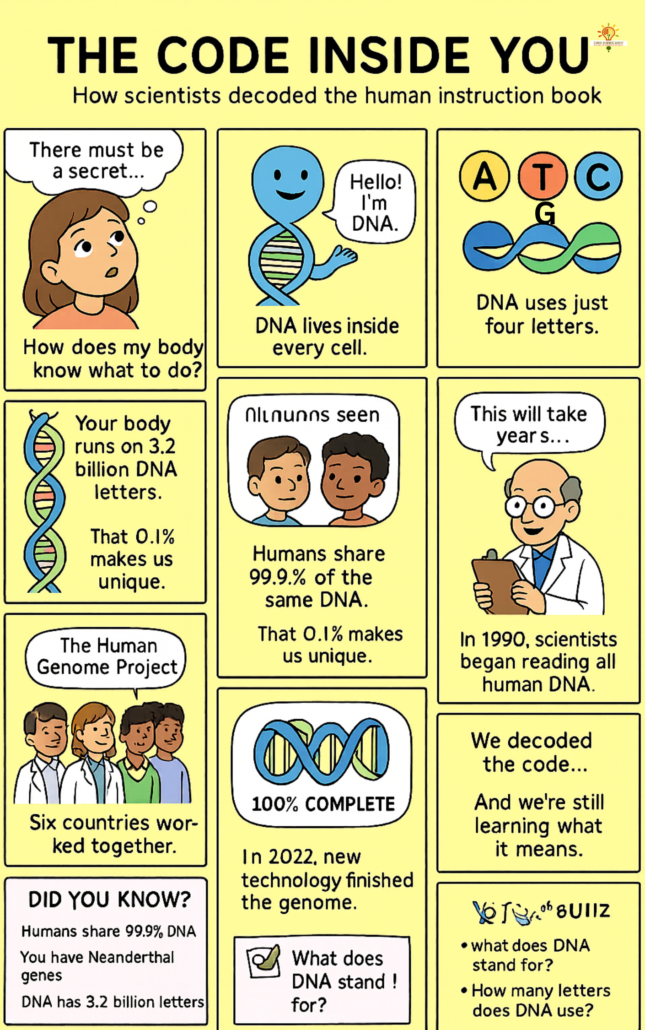
The Code Inside You

This colourful comic explains how DNA works and how scientists decoded the human genome. It shows that DNA lives inside every cell and is written using just four letters i.e. A, T, C, and G. Although humans look different, we share 99.9% of the same DNA.

The comic also highlights the Human Genome Project, where scientists from around the world worked together to read all 3.2 billion DNA letters in the human body. Completed with new technology in 2022, this discovery helps doctors improve treatments, understand diseases, and learn more about human history.

This comic helps students see how their bodies run on a tiny code and how science is still learning to read it.


The Mystery in Photo 51: Rosalind Franklin

Discover & Learn: One Comic At A Time!


The Mystery in the Photo: Rosalind Franklin’s Hidden Legacy

DNA_MYSTERY

In 1952 at King’s College London, Rosalind Franklin captured one of the most important images in scientific history the famous Photo 51. This X-ray diffraction photo revealed the striking “X” pattern, unlocking the secret structure of DNA, the blueprint of life itself. While her ground-breaking contribution laid the foundation for modern genetics and molecular biology, her name was initially left out of the discovery credits. Watson and Crick built their DNA model with insights from her work, but Franklin’s recognition came much later. Today, she is celebrated as a pioneer whose vision and precision inspired generations of scientists. This comic story highlights not just her discovery but also her struggle for acknowledgment in a male-dominated scientific world. Rosalind Franklin didn’t just take a photo but she reshaped humanity’s understanding of life.

Want more comic stories? Let us know in the comments!


The Curious Case of Disappearing Bones!

What happens when bones disappear? Explore the curious science behind vanishing bones. This comic reveals the surprising answer!

“Did You Know? 20 Questions About Butterflies You Never Thought to Ask!”

15 Scientific And Fun Facts About Birds You Must Know!

Scientific and fun! facts about birds

  1. Birds are the only animals with feathers.
    Feathers help them fly, stay warm, attract mates, and even camouflage!

  2. Birds evolved from dinosaurs.
    Yes, your backyard pigeon is a distant cousin of the T. rex!

  3. Hummingbirds can hover in place — and fly backward!
    They beat their wings up to 80 times per second.

  4. Birds have hollow bones, making them light for flight.
    Despite being light, their skeletons are super strong.

  5. The Arctic Tern migrates 70,000 km every year.
    It flies from the Arctic to Antarctica and back — the longest migration on Earth.

  6. Some birds can see ultraviolet light.
    Their vision is much more colourful than ours!

  7. Owls can rotate their heads up to 270 degrees.
    Special bones and blood vessels protect them from injury.

  8. The fastest bird dive? Peregrine falcon at 390 km/h (242 mph)!
    That’s faster than a Formula 1 car.

  9. Birds don’t have teeth — but their beaks are specialized tools.
    Each species has a beak shape suited to its diet.

  10. The kiwi bird lays the largest egg relative to its body size.
    The egg can be up to 20% of the kiwi’s weight!

  11. Parrots and crows are among the smartest birds.
    They can solve puzzles, mimic human speech, and even use tools.

  12. Penguins can’t fly — but they’re excellent swimmers.
    Their wings have evolved into flippers for underwater speed.

  13. Birds have a unique respiratory system with air sacs.
    This allows for a one-way flow of oxygen — much more efficient than ours.

  14. Flamingos are pink because of their diet.
    They eat algae and shrimp rich in carotenoids (natural pigments).

  15. Some birds can sleep while flying.
    Frigatebirds can nap mid-air during long migrations using uni hemispheric sleep (half-brain shut down).


“Mind-Blowing DNA Facts You Did not Know!”


DNA Fun Facts

  1.  You share 99.9% of your DNA with every other human! That tiny 0.1% makes each of us unique.
  2. If you stretched out all the DNA in your body, it could reach the sun and back… 600 times! Yes, your DNA is super long when unwound.
  3. Bananas share about 60% of their DNA with humans! You’re more like a banana than you thought.
  4. You have about 20,000 to 25,000 genes. These genes act like instructions for your body.
  5. You get half of your DNA from your mom and half from your dad. That’s why you might have your mom’s eyes and your dad’s nose.
  6. DNA is in every cell of your body — except red blood cells! Red blood cells don’t have a nucleus, so no DNA there.
  7. Identical twins have nearly the same DNA — but not 100%! Tiny differences can still exist due to mutations.
  8. Your DNA can be used like a fingerprint. That’s why it helps in solving crimes or proving family relationships.
  9. DNA stands for Deoxyribonucleic Acid. Try saying that 5 times fast!
  10. Most of your DNA doesn’t code for anything. Scientists used to call it “junk DNA,” but now they’re finding it might have hidden functions.
  11. Some viruses insert their DNA into yours. About 8% of your DNA actually comes from ancient viruses!
  12. In 2003, scientists finished mapping all human genes. This was called the Human Genome Project — a huge breakthrough in biology.
  13. You can store your entire DNA code in a file smaller than a digital photo. DNA stores information in an extremely compact way.
  14. DNA is shaped like a twisted ladder — a double helix. This shape helps it copy itself perfectly during cell division.
  15. You can get your DNA tested to learn about your ancestry. Want to know where your great-great-grandparents came from? DNA can help!