 curio science quest
 Part 1: The Birth of Cell Theory
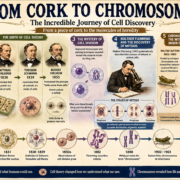
A Journey from Cork to Chromosomes
History of Cell Biology: From Hooke’s Cork Cells to Chromosomes
From Cork to Cells: Robert Hooke and the Birth of Cell Biology
What is the history of cell biology?
The history of cell biology began with Robert Hooke’s observation of cork cells in 1665 and progressed through the discoveries of Leeuwenhoek, Brown, Schleiden, schwann, Virchow and Flemming.
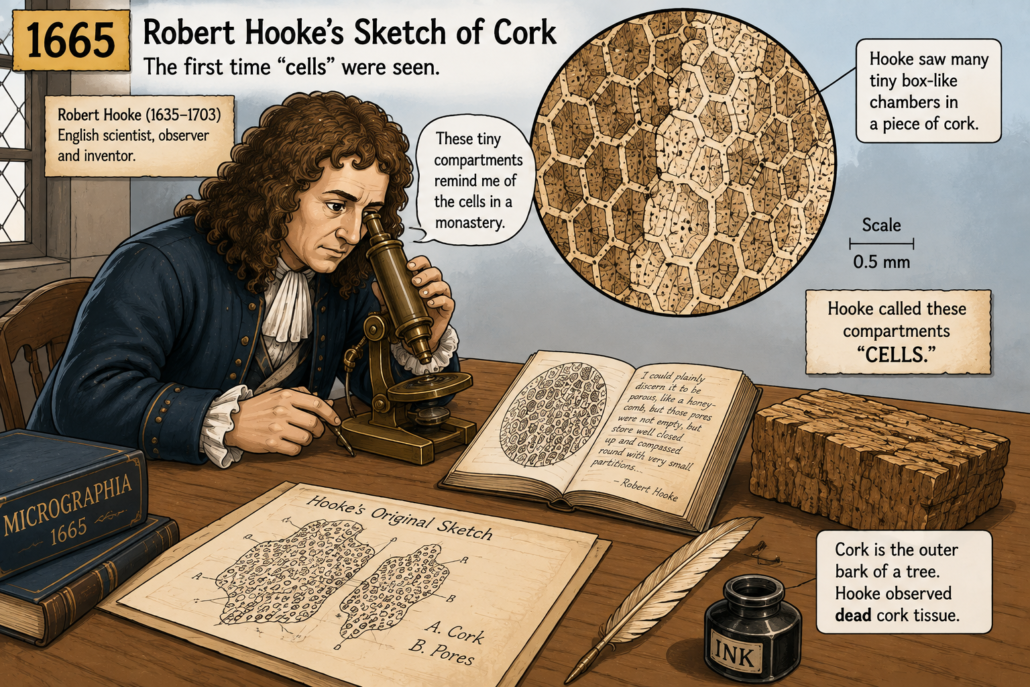
Imagine peeling the bark from a tree and placing a thin slice under a primitive microscope. That is exactly what happened in 1665, when the English scientist Robert Hooke looked at cork. Through his hand-built compound microscope, he saw something no one had described before: tiny, box-like compartments.
Hooke thought they looked like the small rooms where monks lived. He called them “cells.”
This was the first recorded use of the word “cell” in biology. Of course, Hooke was not actually seeing living cells. He was looking at the empty walls of dead plant tissue. The living contents had long dried away, leaving behind only the rigid outlines.
But his observation was revolutionary. Hooke’s book Micrographia (1665) inspired curiosity across Europe. The idea that nature could be studied with magnifying lenses became a serious pursuit.
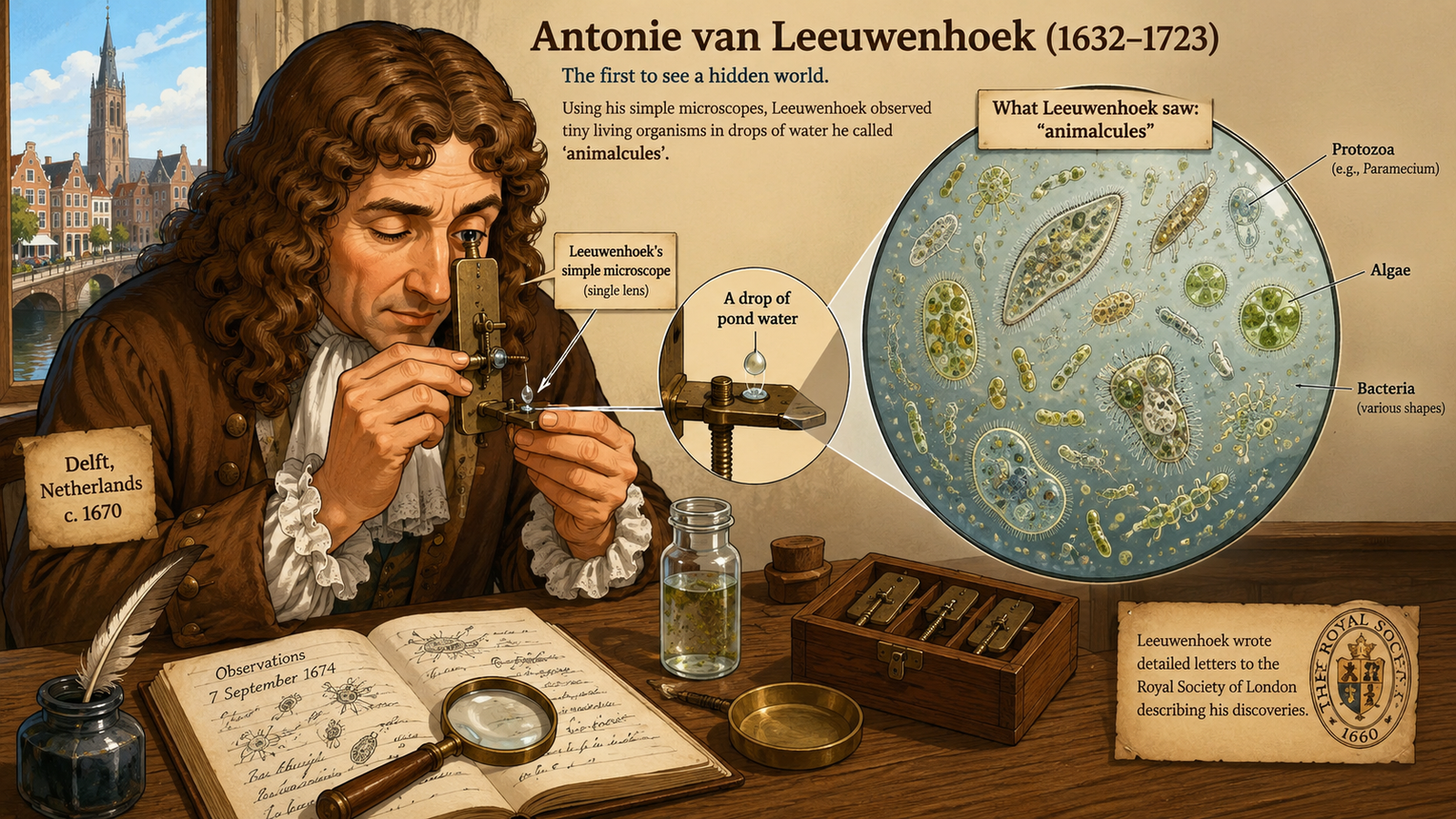
At the same time, another pioneer was grinding glass into lenses that were far better than Hooke’s. This man was Antonie van Leeuwenhoek, a Dutch tradesman with a passion for magnification. His microscopes were small, single-lens devices, but they were powerful
Leeuwenhoek used his lenses to look at everything he could imagine from pond water, blood, semen, even scrapings from his own teeth. What he discovered amazed the world. He described tiny moving creatures that no one had seen before and named them ‘animalcules.
These were the first recorded observations of living microorganisms, bacteria, protozoa, and even sperm cells.
For the first time, people began to understand that life was built from tiny, hidden structures. But there was still no single theory to explain it all. Hooke had described cells in plants, and Leeuwenhoek had observed animal and bacterial forms. The connection between them remained unclear.
More than 150 years would pass before scientists connected these dots.
The Nucleus Appears
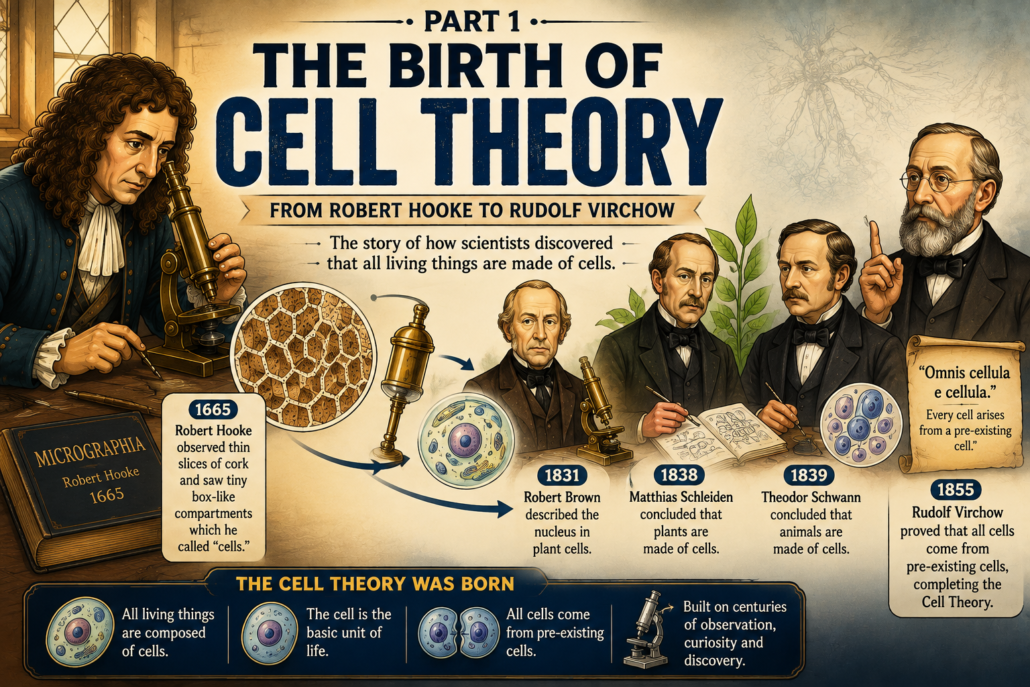
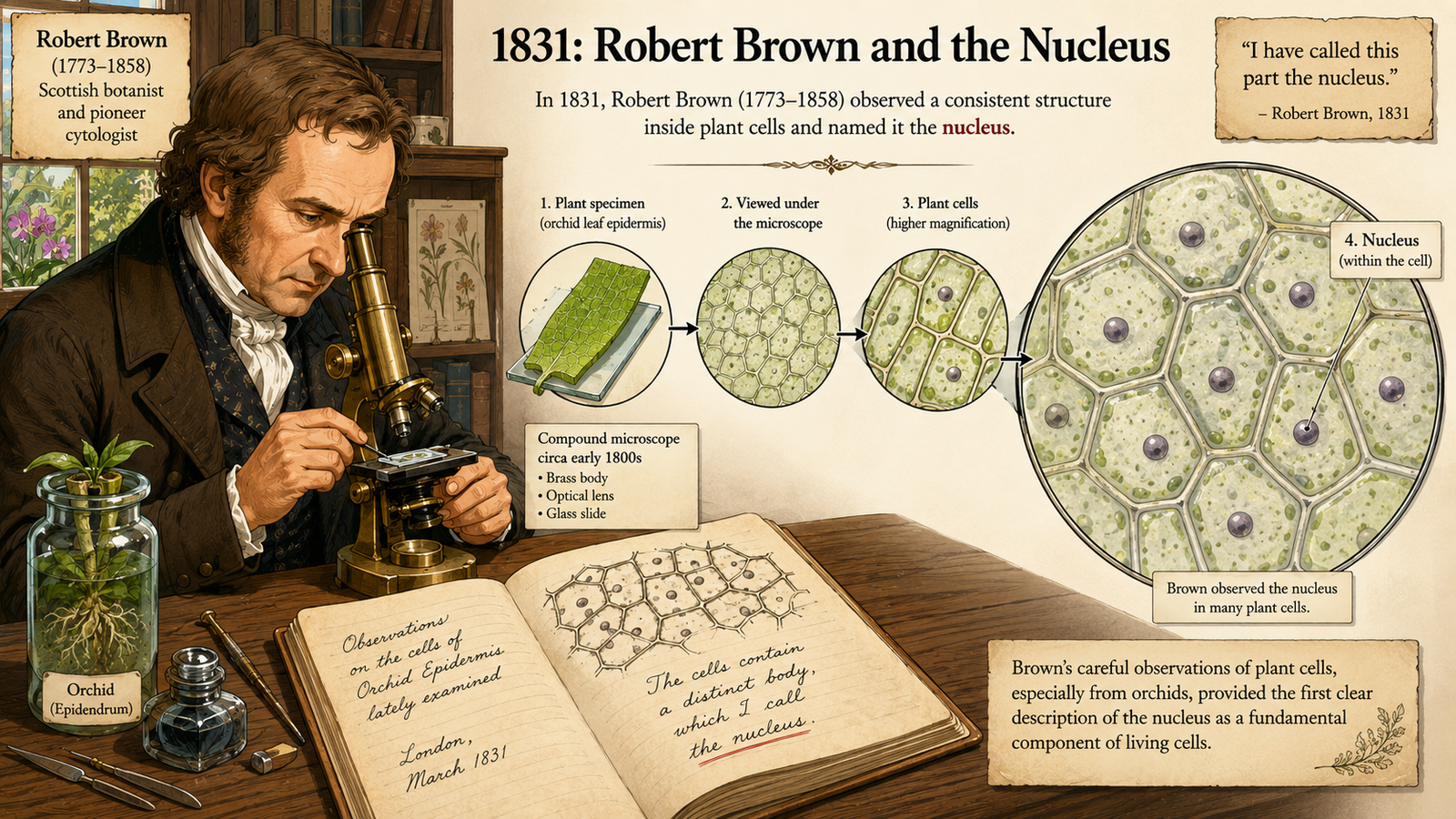
In 1831, Scottish botanist Robert Brown was studying orchids. While observing the cells of these plants, he noticed a consistent, dark, rounded body inside each one. He named it the nucleus.
This was a turning point. Cells were not just empty spaces surrounded by walls. They had internal parts. They had organization. The nucleus seemed to be a central structure, and later it would prove essential for heredity.
The Cell Theory
By the 1830s and 1840s, microscopes were improving. Glassmaking had advanced, and staining methods with dyes like carmine and iodine made cellular details easier to see.
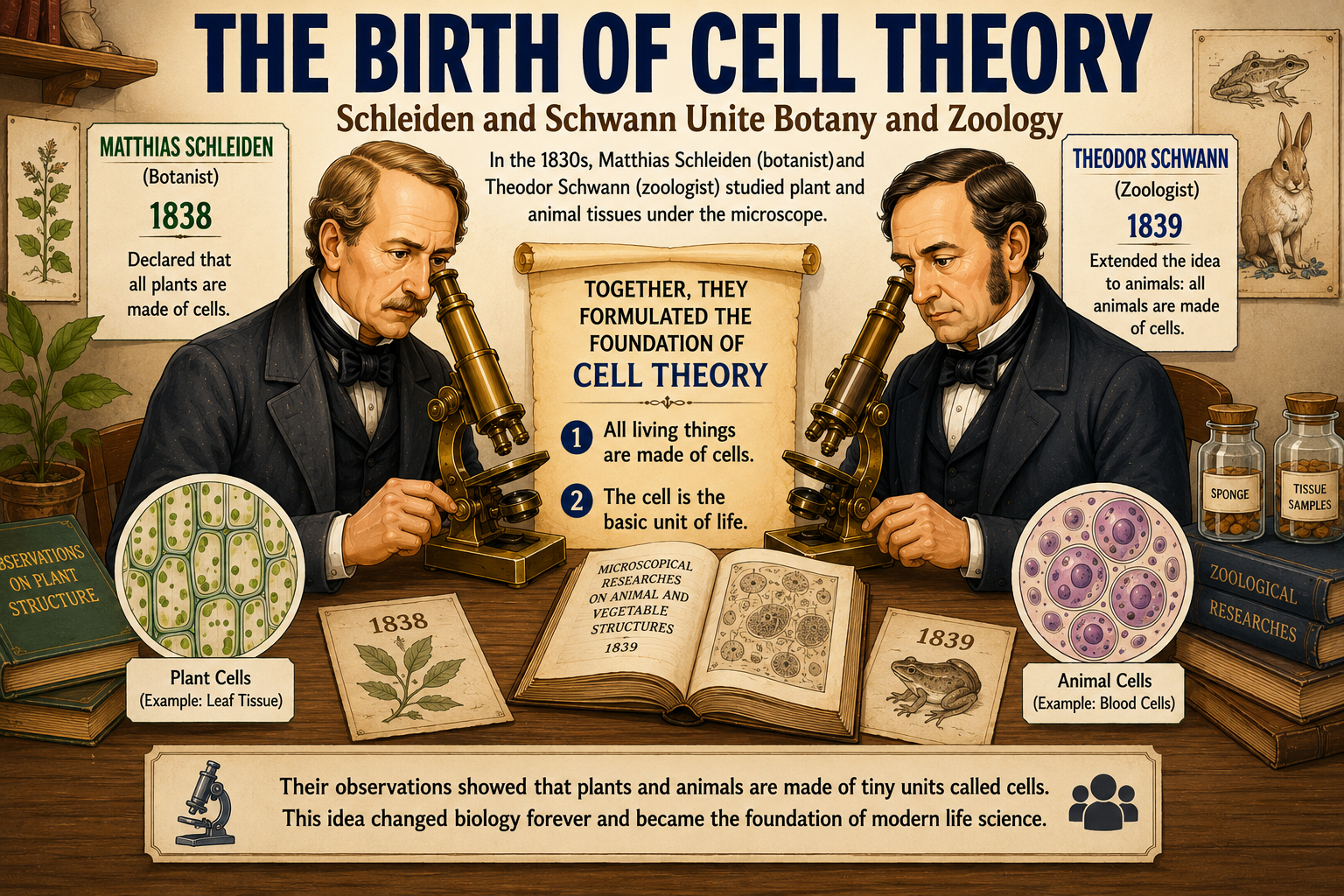
In Europe, two scientists named Matthias Schleiden (a botanist) and Theodor Schwann (a zoologist) began studying plant and animal tissues under the microscope.
In 1838, Schleiden declared that all plants are made of cells. In 1839, Schwann extended the idea to animals. Together, they laid down the foundation of what became known as the Cell Theory:
- All living things are made of cells.
- The cell is the basic unit of life
This was revolutionary. Suddenly, plants, animals, and even humans were united by a common building block.
Yet one mystery remained: Where do new cells come from?
At the time, many scientists still believed in “spontaneous generation” the idea that life could appear out of non-living matter. Some thought cells could simply crystallize or form a new inside organisms.
It was not until 1855 that German physician Rudolf Virchow delivered the famous phrase: “Omnis cellula e cellula.” Every cell comes from another cell.
This simple idea challenged the long-held belief that cells could arise by spontaneous generation. It showed cells, could not appear from nothing but they had to come from the division of pre-existing cells.
Virchow’s principle would become the third pillar of the Cell Theory.
A Hidden Process
But here lay the puzzle: How exactly does one cell become two?
Scientists had no clear picture of the process. They could sometimes glimpse strange, thread-like structures inside dividing cells, especially when they used new stains. But these observations were brief and confusing.
The stage was set for a discovery that would change biology forever the discovery of mitosis, the process of cell division.
Part 2: The First Clues of Cell Division, we will explore the 1800s when new dyes and microscopes revealed mysterious threads inside cells, and Virchow’s principle met its first experimental tests. Continue the journey…..
The Secret of Mitosis: How Scientists Discovered Cell Division
 Curio Science Quest
 curio science quest
 curio science quest
 curio science quest
 curio science quest
Leave a Reply
Want to join the discussion?Feel free to comment!