Part 4: The story of chromosomes and inheritance
A Journey from Cork to Chromosomes
The Secret of Mitosis: How Scientists Discovered Cell Division
Chromosomes and the Secret of Inheritance
Walther Flemming had shown the precise and orderly sequence of cell division. But what were those mysterious threads? Why did they divide so carefully? And what did they carry?
The answers would come from a new generation of scientists at the turn of the 20th century.
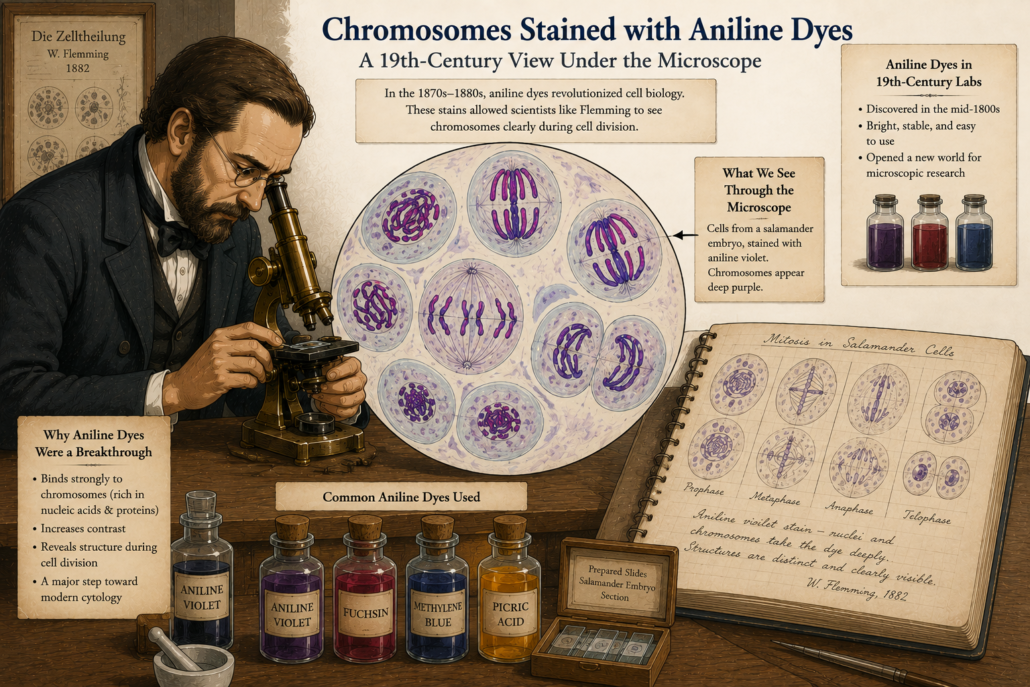
Chromosomes Get Their Name
In 1888, a German anatomist named Heinrich Wilhelm Waldeyer gave the threads a new name: chromosomes.
- “Chromo” means colour.
- “Soma” means body.
Why? Because they picked up colour so vividly with the new dyes. The name stuck, and chromosomes became the stars of cell biology.
From Mitosis to Inheritance
Scientists now knew that chromosomes split evenly during mitosis. That meant daughter cells always received the same number. But another big mystery remained: How were traits passed from parents to offspring?
Gregor Mendel had already published his famous pea plant experiments back in 1866, showing that traits followed mathematical rules of inheritance.
Yet his work was forgotten for decades.
When it was rediscovered around 1900, scientists suddenly had two puzzles to connect:
- Mendel’s invisible units of heredity.
- The visible chromosomes that divided with such precision.
Could they be the same thing?
Theodor Boveri: A Careful Experimenter
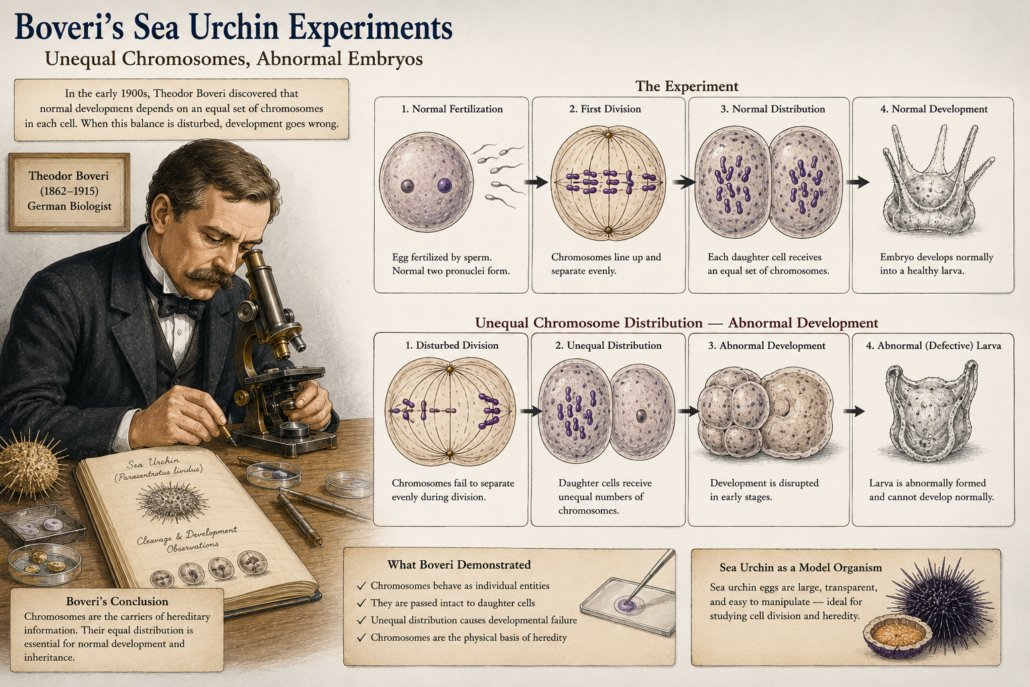
The German biologist Theodor Boveri (1862–1915) was one of the first to see the connection.
Working with sea urchin eggs, he performed delicate experiments. Sea urchins were perfect because their eggs were transparent, large, and divided rapidly. Boveri discovered something striking:
- A cell could not develop properly unless it received a complete set of chromosomes.
- If the distribution was abnormal if too many or too few chromosomes went into a cell, development failed.
This meant chromosomes were not just visible threads. They carried essential information needed for life.
Chromosomes as the Carriers of Heredity
Boveri concluded: chromosomes must be the physical carriers of heredity. Every single one mattered.
He was cautious but confident but the chromosomes were not identical; each had unique information. This was revolutionary. He had taken Flemming’s careful descriptions and added a powerful idea: chromosomes were not just for cell division, but also for inheritance of traits.
Walter Sutton and the Chromosome Theory
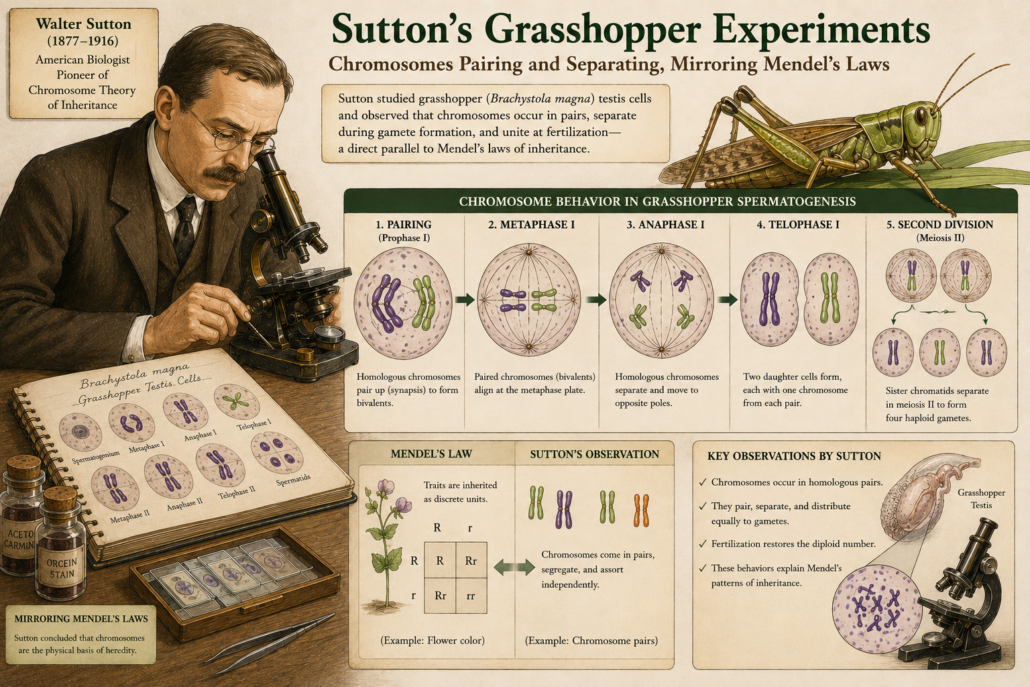
At the same time, across the Atlantic, a young American scientist named Walter Sutton was studying grasshopper cells. In 1902, Sutton noticed that chromosomes came in pairs. During cell division, each pair separated, with one chromosome going to each new cell. He realized this matched Mendel’s laws of inheritance:
- Each parent contributes one factor (gene).
- The factors separate and combine again in offspring.
Chromosomes behaved exactly like Mendel’s “hereditary units.”
The Chromosome Theory of Inheritance
Together, Boveri and Sutton laid the foundation for the chromosome theory of inheritance.
It said:
- Genes are located on chromosomes.
- Chromosomes are passed from cell to cell, and from parent to offspring, through mitosis and meiosis.
This was the missing link between cell biology and genetics.
Why This Was a Turning Point
Up until Flemming, mitosis was just a strange cellular dance. With Boveri and Sutton, the meaning became clear:
- Chromosomes were the carriers of heredity.
- Mitosis ensured that every new cell received the full library of instructions.
- Life’s continuity, from one cell to another, depended on this precise mechanism.
The mystery of cell division had transformed into the foundation of modern genetics.
A Legacy That Still Shapes Science
Today, we know chromosomes are made of DNA tightly wrapped around proteins.
We know they carry thousands of genes that code for every trait in living organisms.
But that knowledge rests on the careful experiments of Flemming, Boveri, Sutton, and their colleagues.
They took what seemed like meaningless threads and revealed them as the very carriers of life’s code.
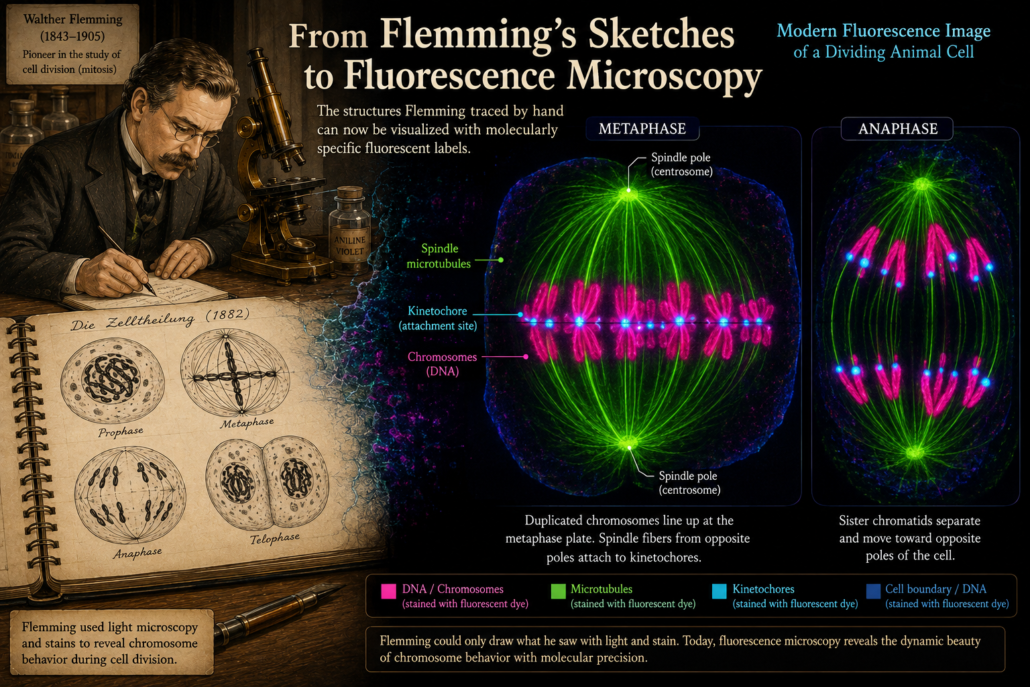
Part 5: Why Mitosis Matters Today, we will explore how this history connects to modern science: from cancer research to cloning, stem cells, and genetic medicine. Continue the journey…
Part 5: Why Mitosis Matters.
Let, connect the history to modern discoveries and why cell division still holds so many secrets.