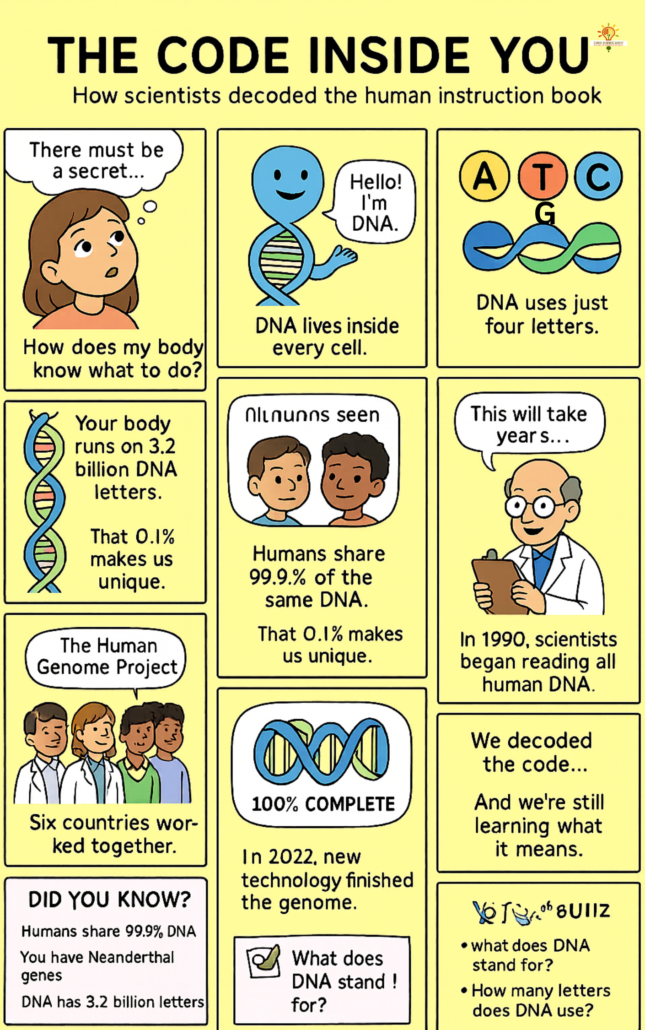
This colourful comic explains how DNA works and how scientists decoded the human genome. It shows that DNA lives inside every cell and is written using just four letters i.e. A, T, C, and G. Although humans look different, we share 99.9% of the same DNA.
The comic also highlights the Human Genome Project, where scientists from around the world worked together to read all 3.2 billion DNA letters in the human body. Completed with new technology in 2022, this discovery helps doctors improve treatments, understand diseases, and learn more about human history.
This comic helps students see how their bodies run on a tiny code and how science is still learning to read it.
https://curiosciencequest.com/wp-content/uploads/2025/12/code-inside.png10241024info@curiosciencequest.comhttp://curiosciencequest.com/wp-content/uploads/2025/03/Untitled_design__1_-removebg-preview-1-300x300.pnginfo@curiosciencequest.com2025-12-15 08:07:432026-09-11 12:03:09How Scientist Decoded The Human Genome
Genome: The Autobiography of a Species in 23 Chapters
Matt Ridley’s Genome: The Autobiography of a species in 23 chapters is an extraordinary exploration of the human genetic code, unravelling the mysteries hidden within our DNA.
Summary:
The book presents a fascinating journey through the 23 pairs of chromosomes that make up the human genome, each chapter delving into a specific gene or genetic concept that has shaped who we are as a species.
Ridley’s writing is engaging and accessible, making complex scientific concepts understandable and exciting for readers of all ages. He weaves together stories of scientific discovery, historical events, and personal anecdotes, painting a vivid picture of how our genes influence everything from our physical traits to our behaviour, health and even our susceptibility to certain diseases.
What makes Genome particularly captivating is Ridley’s ability to connect the science of genetics to broader themes of human identity, evolution and future of medicine. Whether you are a curious teenager, a college student with an interest in biology, or an adult looking to understand the roots of human diversity, this book offers something for everyone. It sparks curiosity about the very building blocks of life and leaves readers with a deeper appreciation for the intricate tapestry of our genetic heritage.
Overall, Genome is a must-read for anyone interested in understanding what makes us human. Ridley’s ability to make science not only understandable but also thrilling ensures that this book will captivate readers of all ages, inspiring them to delve into wonders of genetics.
The Tiny Genius That Changed Science: Drosophila melanogaster
The Little Fly With a Big Secret You have probably seen it buzzing around your bananas — tiny, fast, and easy to miss. But did you know this little fly has helped scientists unlock some of the biggest mysteries in biology?
👉 Meet Drosophila melanogaster — the common fruit fly and the unexpected superstar of science!
This tiny insect may live for just a few weeks, but it’s made a massive impact. For over 100 years, scientists have studied fruit flies to discover how traits like eye colour, height, and even diseases are passed from parents to children. In fact, this bug was key to figuring out how genes work — long before we could even see DNA!
From your kitchen to the world’s top laboratories, the fruit fly has proven that even the smallest creatures can make the biggest difference.
A Riddle to Begin…
Let’s start with a riddle:
“Tiny wings, a simple fly, Yet I helped science touch the sky. With mutants, traits, and gene displays, In my short life, I led the way. What insect launched genetic fame?”
Answer:Drosophila melanogaster — The fly that taught humans about heredity!
Why Fruit Flies?
You might wonder: why study flies when we’re trying to understand human biology?
Well, it turns out that fruit flies are a perfect model organism for several reasons:
Short Life Cycle: A fruit fly grows from an egg to an adult in about 10 days. This means scientists can observe many generations quickly.
Simple Genome: Fruit flies have only 4 pairs of chromosomes, making it easier to study their DNA.
Easy to Keep in the Lab: They are small, don’t take up much space, and reproduce quickly — a dream for scientists!
Surprisingly Similar to Humans: Even though they’re tiny, fruit flies share about 60% of their genes with humans. Many of the genes that control development and disease in flies are similar to those in us.
The Beginning of Genetic Discovery
The real fame of Drosophila started in the early 1900s with a scientist named Thomas Hunt Morgan. He and his team at Columbia University began experimenting with fruit flies to understand how traits are passed from one generation to the next.
Here’s what they discovered:
Mutations Matter: By studying flies with white eyes (instead of the usual red), Morgan proved that genes are carried on chromosomes.
Sex-Linked Traits: He also showed that some traits are linked to sex chromosomes, which helped explain why some genetic diseases affect boys more than girls.
Gene Mapping: Morgan’s team created the first genetic maps, showing where genes are located on a chromosome.
For his ground breaking work, Thomas Hunt Morgan won the Nobel Prize in 1933. His research with Drosophila laid the foundation of modern genetics.
A Tiny Teacher in Modern Science
Even after more than 100 years, fruit flies are still teaching us new things!
Here’s what they’re helping us study today:
Brain and Behaviour: Scientists study how fruit fly brains control learning, memory, and sleep.
Disease Research: Fruit flies are used to model diseases like cancer, Parkinson’s, and Alzheimer’s — helping to test treatments.
Development: From a single cell to a full adult, fruit flies help us understand how living things grow and develop.
All of this is possible because we can control and observe mutations easily in fruit flies. Their transparent embryos, fast life cycle, and detailed genetic tools make them ideal for deep scientific exploration.
The Legacy of a Little Fly
From the kitchen counter to the Nobel stage, the journey of Drosophila melanogaster is nothing short of amazing. It has shown the world that even the smallest creatures can reveal life’s biggest secrets.
This tiny fly continues to help us answer questions like:
How do genes control growth?
Why do genetic diseases happen?
Can we fix or treat genetic disorders?
And many more…
Want to Explore More?
If you loved learning about this tiny genius, there’s so much more to explore in the world of genetics! From bacteria and worms to mice and zebrafish, science uses many amazing creatures to unlock the secrets of life.
Subscribe to our website for more fun and fascinating science facts. Share this blog with fellow science lovers, and Tell us in the comments — what other model organisms would you like to learn about next?
💡 Fun Fact:
A single female fruit fly can lay over 500 eggs in her lifetime. No wonder labs always have plenty of flies to study!
https://curiosciencequest.com/wp-content/uploads/2013/12/WhatsApp-Image-2025-04-09-at-8.31.12-PM.jpeg554554info@curiosciencequest.comhttp://curiosciencequest.com/wp-content/uploads/2025/03/Untitled_design__1_-removebg-preview-1-300x300.pnginfo@curiosciencequest.com2025-04-06 18:48:002026-09-03 15:15:31What Can a Fruit Fly Teach Us About Ourselves? More Than You Think