 curio science quest
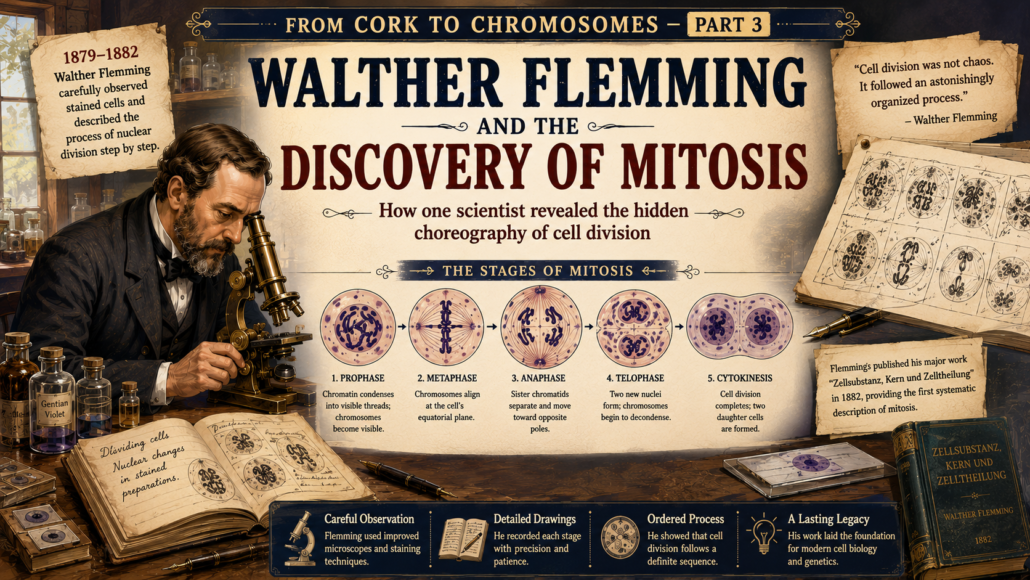
Part 3: Walther Flemming and the Discovery of Mitosis
A Journey from Cork to Chromosomes
The Secret of Mitosis: How Scientists Discovered Cell Division
By the 1870s, scientists were catching glimpses of strange fibers inside the nucleus. Threads appeared, moved, and vanished during cell division. But no one had yet mapped the full sequence.
That changed with Walther Flemming.
The Scientist Behind the Discovery
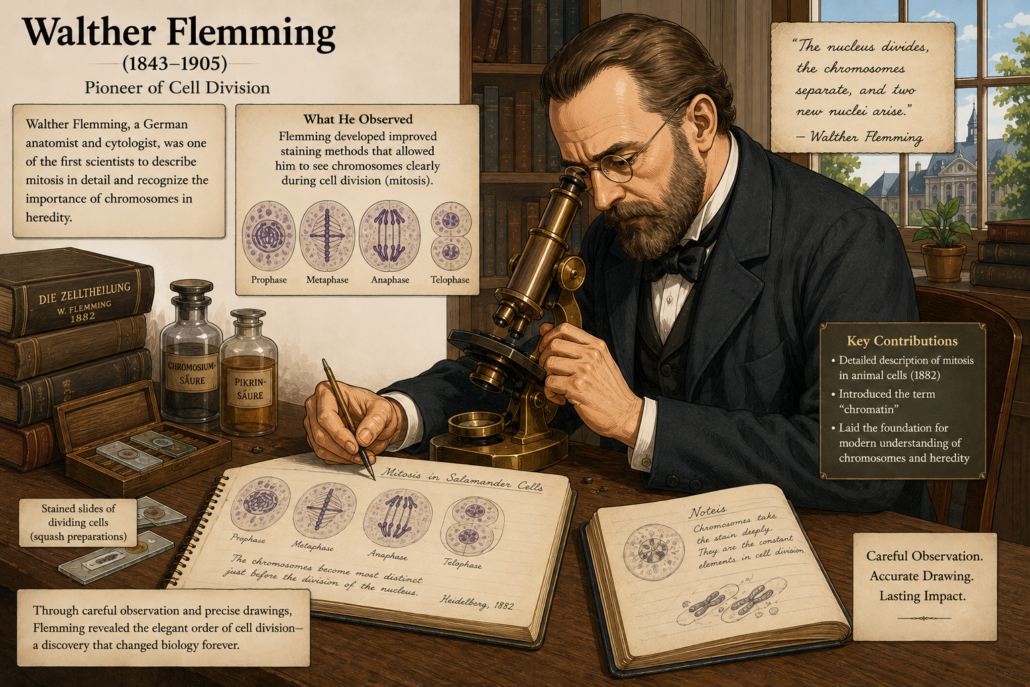
Walther Flemming (1843–1905) was a German anatomist and physician. He trained as a doctor but was drawn to microscopic anatomy the fine details of tissues and cells.
Unlike earlier observers, Flemming had access to better microscopes and a new set of tools: aniline dyes.
These were synthetic colours developed from coal tar in the mid-19th century. They bound strongly to cell structures, especially the nucleus, and gave sharper, more consistent results than natural stains like carmine.
Flemming realized that with the right stains, he could follow the nucleus in fine detail as a cell divided.
A Patient Observer
Flemming spent years staring down the microscope at thin slices of tissue salamander embryos, corneal cells, and other transparent specimens where nuclei were easy to see.
He would watch patiently, draw what he saw, and compare hundreds of observations. Slowly, a clear pattern emerged. He saw that cell division was not random or disorderly, but it followed a precise, step-by-step process rather than occurring by chance.
The Stages of Mitosis
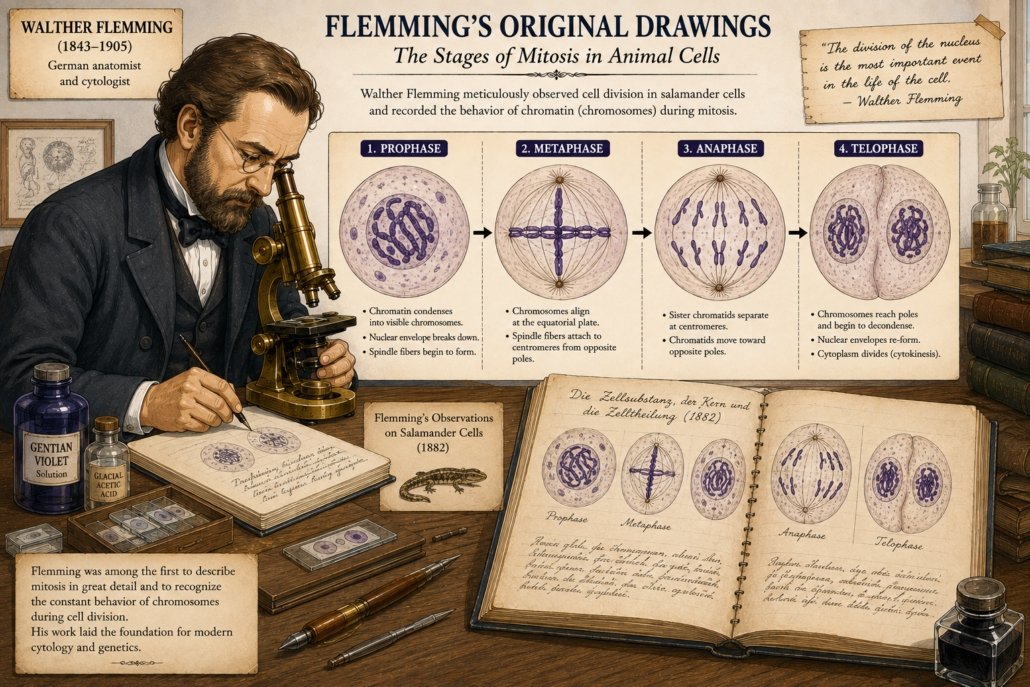
Flemming documented a series of stages that every dividing nucleus seemed to pass through:
- Prophase – The nucleus, normally round and quiet, suddenly filled with long, dark threads. These threads shortened and thickened, becoming more distinct.
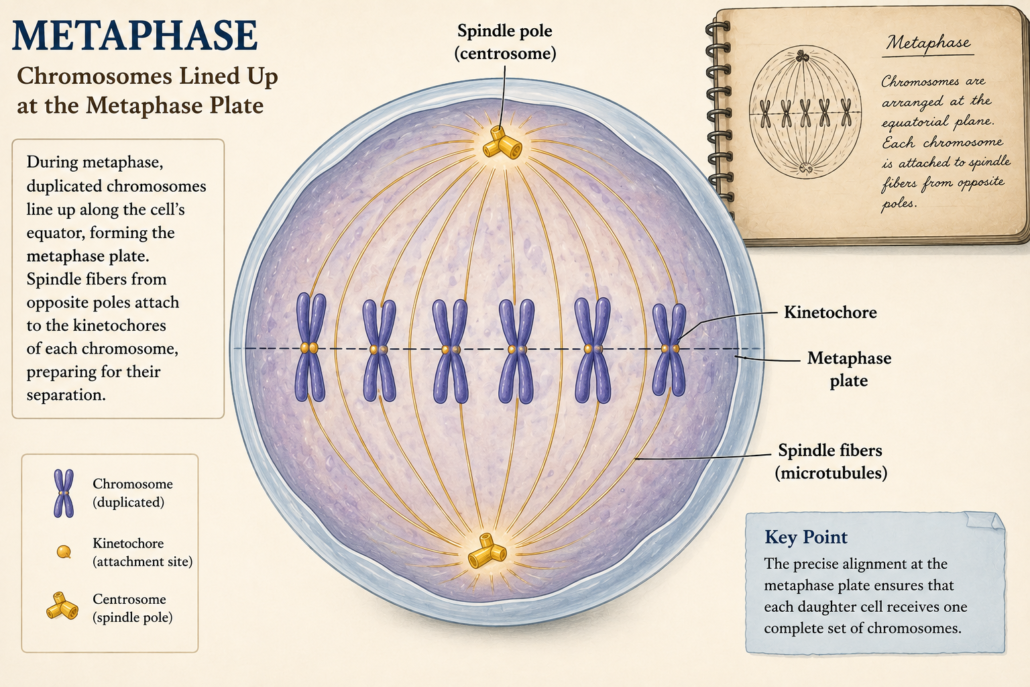
(We now know these threads are chromosomes condensing.) - Metaphase – The threads arranged themselves in the middle of the cell, forming a striking plate-like structure.
(We now call this the metaphase plate.) - Anaphase – The threads split lengthwise. Each half moved steadily to opposite ends of the cell.
(This ensures each new cell receives the same set of chromosomes.) - Telophase – At the two ends, the threads disappeared again into a fine network, and new nuclei re-formed.
Finally, the whole cell itself divided, producing two daughter cells, each with a complete nucleus.
Naming the Process
In 1882, Flemming published his great work, Cell Substance, Nucleus, and Cell Division.
In it, he coined the term “mitosis,” from the Greek word mitos, meaning “thread.”
It was a perfect description: division looked like a dance of threads inside the cell.
Why It Was Revolutionary
Flemming had achieved something extraordinary. For the first time in history, scientists could see how one cell became two at the nuclear level.
- He proved that division was not random but it followed a reproducible sequence.
- He gave names and drawings that future scientists could use and refine.
- He opened the door to understanding inheritance, because whatever these “threads” were, they clearly carried something important into daughter cells.
At the time, no one knew these threads were chromosomes containing DNA. That connection would come later. But Flemming’s careful descriptions laid the foundation.
A Turning Point: Metaphase
Metaphase was the most striking stage Flemming described. For the first time, scientists observed chromosomes aligning in a precise order. This was not random. It indicated an internal mechanism controlling their movement. Cell division was therefore not just a physical split but a highly organized biological process.
Legacy of Flemming
Flemming did not live to see the discovery of DNA or the chromosome theory of inheritance.
But without him, those later insights would not have been possible.
His drawings remain iconic even today. Modern fluorescent microscopy confirms almost exactly what he sketched by hand more than 140 years ago.
Walther Flemming showed the world the secret arrangement inside the cell.
He gave us the language, the stages, and the concept of mitosis.
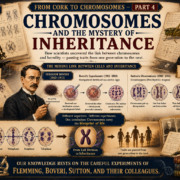
Part 4: Chromosomes and Inheritance, we will explore how scientists like Theodor Boveri and Walter Sutton realized that chromosomes were not just threads but they were the very carriers of heredity. Continue the journey…
Part 4 The story of chromosomes and inheritance.
This is where mitosis connects to heredity and the secret of life itself.
 curio science quest
 curio science quest
 curio science quest
 Curio Science Quest
 curio science quest
 Curio Science Quest
Leave a Reply
Want to join the discussion?Feel free to comment!