Part 5: Why Mitosis Matters
A Journey from Cork to chromosomes
The Secret of Mitosis: How Scientists Discovered Cell Division
Why Mitosis Matters Today
The story of mitosis is not just history. It is a living science. Every day, billions of your cells divide through mitosis. Without it, growth, repair, and life itself would not be possible. But mitosis is more than just a biological fact. It is a key to medicine, biotechnology, and the future of human health.
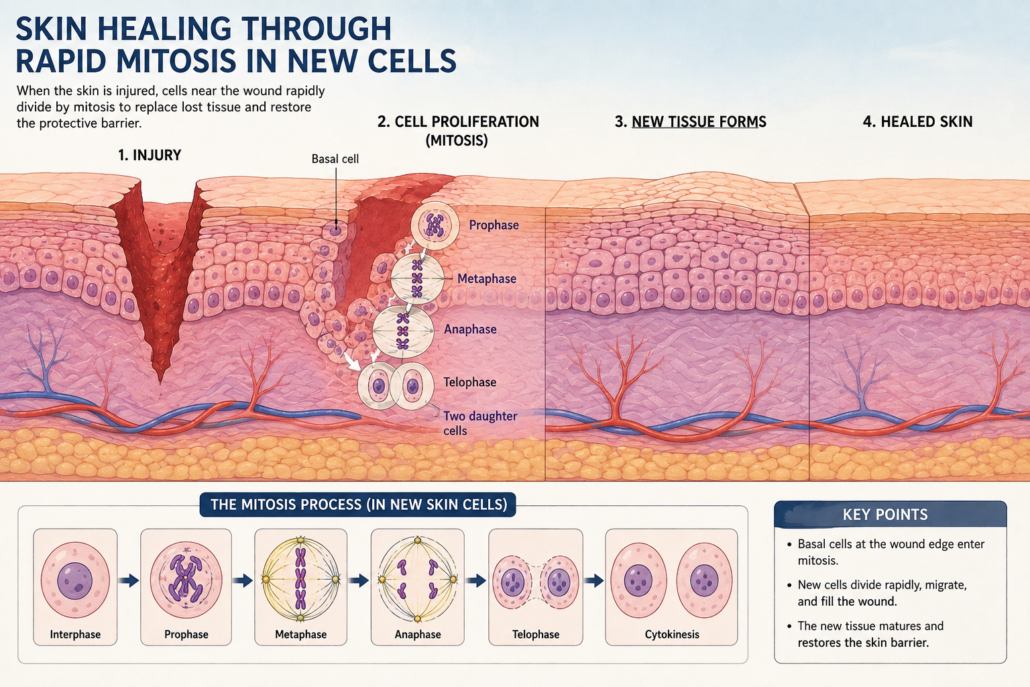
Mitosis in Growth and Healing
Think about a child growing taller. Or a cut on our skin closing as new tissue forms. Or the lining of our stomach renewing itself every few days.
All of these depend on mitosis. It ensures that each new cell is an exact copy of the one before. That continuity keeps tissues functioning, organs working, and bodies alive.
When Mitosis Goes Wrong:
Cancer
But precision is crucial. If something goes wrong during mitosis, the results can be dangerous. Sometimes, a cell may divide uncontrollably. Instead of stopping when enough new cells are made, it keeps dividing. This is how cancer begins. Cancer is, in many ways, a disease of cell division. That is why scientists study mitosis so closely. Understanding the checkpoints, the signals, and the safeguards can lead to better treatments.
Chromosomes and Genetic Disorders
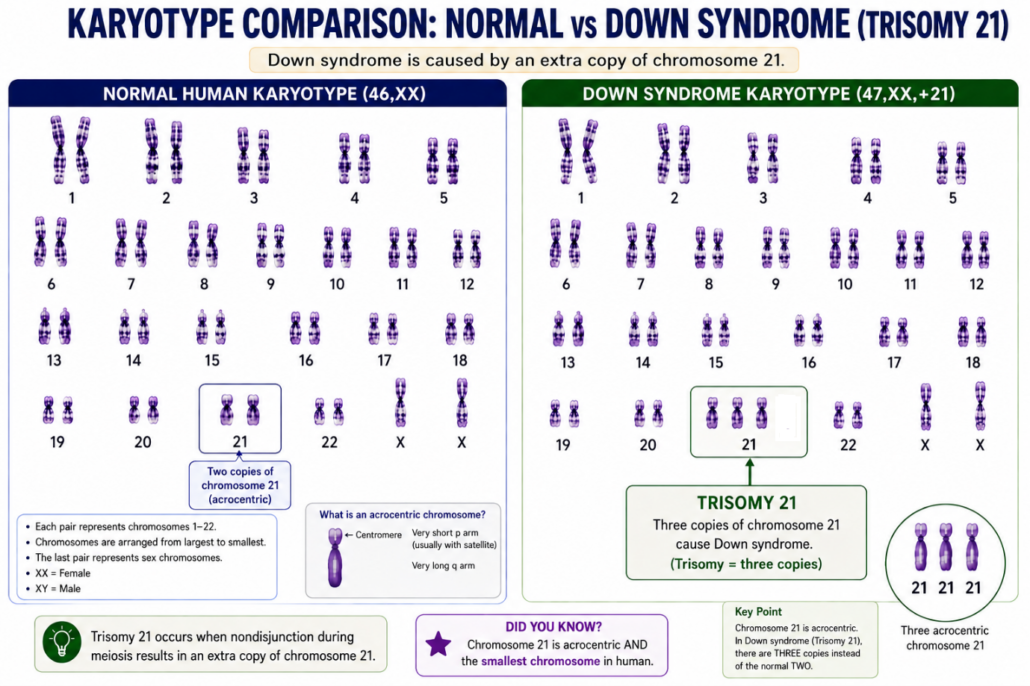
Mitosis also helps explain genetic disorders. If chromosomes are not copied or divided correctly, cells may end up with extra chromosomes or lack some. This can lead to developmental problems or diseases. For example:
- Down syndrome happens when cells have an extra copy of chromosome 21.
- Some disorders, like Cri-du-chat syndrome, happen when a small part of chromosome 5 is missing. Doctors have also found many other chromosomal disorders that occur when chromosomes are missing pieces or are rearranged.
Boveri’s insight that every chromosome matters are still guiding science today.
Stem Cells and Regenerative Medicine
In modern labs, scientists harness mitosis in new ways. Stem cells are special because they can divide many times and become different types of cells.
- In theory, they can repair damaged organs.
- They can be used to grow tissues for transplants.
- They could one day help cure diseases like Parkinson’s or heart failure.
All of this depends on the basic machinery of mitosis that is cells copying and dividing properly.
Mitosis and the Future of Genetics
The story also connects to DNA. In 1953, Watson and Crick revealed the double helix structure of DNA. That discovery explained what chromosomes are made of. Now we know genes lie along DNA, and chromosomes are their carriers. Every time a cell divides, mitosis ensures each new cell gets a complete copy of the genetic library. Today, with technologies like CRISPR gene editing, scientists can even change that library. But the properly copying and dividing lays the foundation of life’s continuity, still rests on mitosis.
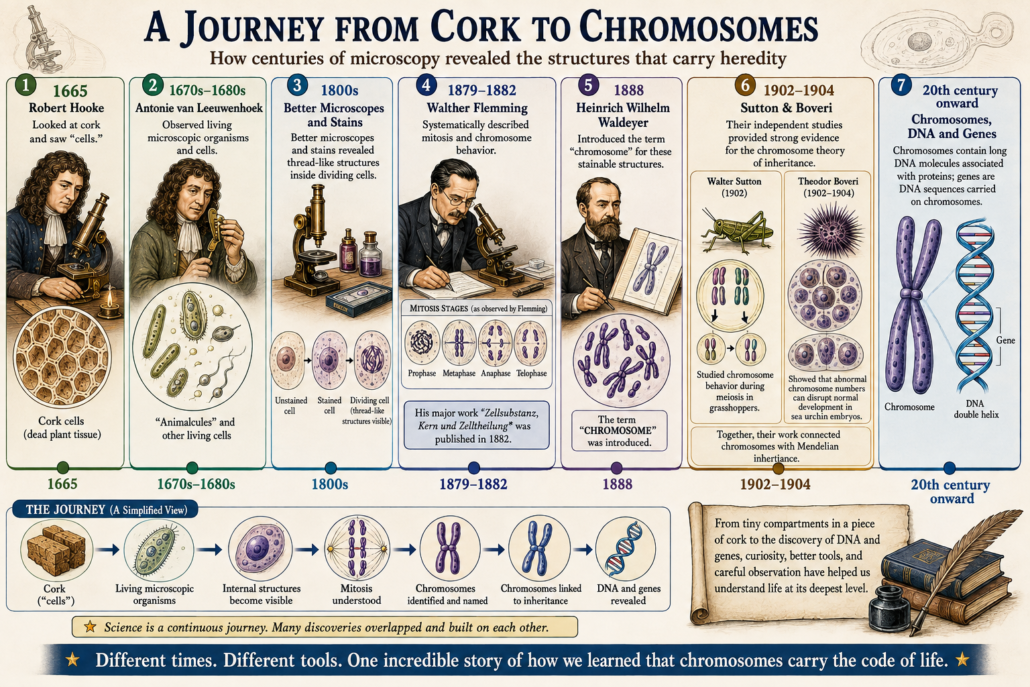
A Journey from Cork to Chromosomes
Let’s step back and remember the journey:
- 1665: Robert Hooke looked at cork and saw “cells.”
- 1670s: Antonie van Leeuwenhoek peered into living cells for the first time.
- 1800s: New dyes revealed thread-like structures inside dividing cells.
- 1879: Walther Flemming carefully described mitosis in his book Cell Substance, Nucleus, and Cell Division.
- 1888: Waldeyer named them “chromosomes.”
- 1902–1904: Boveri and Sutton showed chromosomes were essential for inheritance.
- 20th century onward: Chromosomes were revealed to be made of DNA, carrying genes.
It is a story of patience, of small steps, and of great leaps.
Why This Story Matters
The discovery of mitosis shows how science works. It is not the result of one genius moment.
It is the outcome of centuries of curiosity, mistakes, improvements, and persistence.
From simple cork slices to high-powered microscopes, every discovery built on the last. Each scientist asked questions, saw something new, and passed the torch forward.
And today, when doctors fight cancer, or researchers grow tissues in a lab, or geneticists unlock the secrets of DNA, they are continuing that same journey.
Conclusion:
Mitosis is more than a cellular process. It is a story of life repeating itself, constantly, billions of times. It is the thread that connects us to our ancestors and carries us into the future. Every heartbeat, every breath, every moment somewhere inside us, mitosis is happening. The dance of the chromosomes goes on. And with it, the secret of life continues.
The process once observed through early microscopes is now central to understanding how organisms grow, tissues repair themselves, chromosomes are distributed, genetic disorders arise, and what can happen when normal cell-cycle control breaks down.